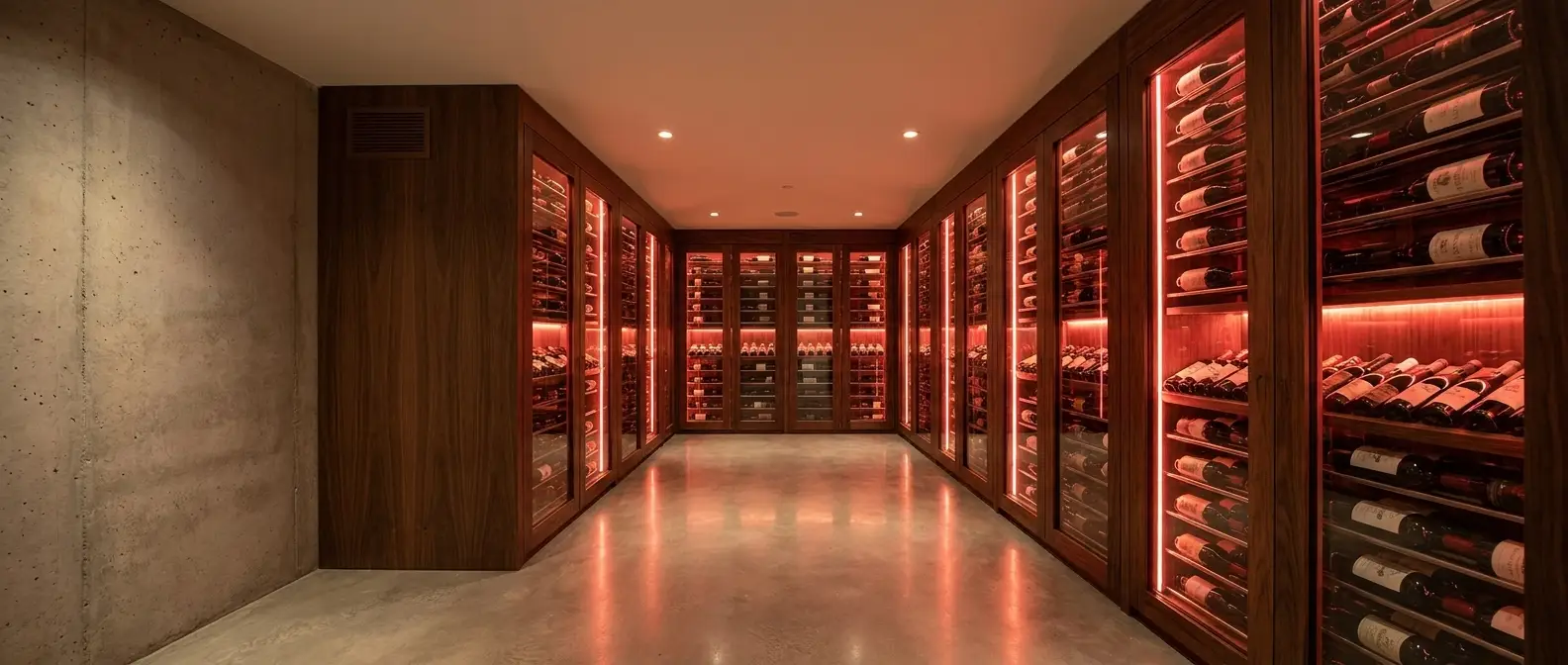
Modern wine cellar with a clean, well-built architectural envelope

Before you build · Drawing set 01

How to build
a wine cellar

Nine cooling decisions that are cheap on paper and expensive after drywall. Fill in the room, check them off, take a one-pager to the contractor.

Title block

BYB-01

  1. 01Build the envelope first
  2. 02Size the cooling load correctly
  3. 03Choose the cooling architecture
  4. 04Plan the ambient window
  5. 05Get the electrical right
  6. 06Set the targets and understand humidity
  7. 07Design for quiet and no vibration
  8. 08Choose your refrigerant for the long term
  9. 09Install and commission properly

Settle these before framing

Decisions

Nine

Envelope through install

Envelope

R-20

R-30 on exterior or attic

Ambient window

50–77°F

Air around the condenser

Install

Licensed HVAC

DIY voids the warranty

Most wine cellar cooling problems are decided long before the unit gets picked, in the envelope, the sizing, and where the heat goes. Work through these nine steps while it's still lines on a plan.

Written and reviewed by

Panthaire HVAC Engineering Team · Licensed HVAC · Wine Cellar Cooling Specialists

The team that engineers APEX is the same team that ships it and answers the phone when installers call.

Last reviewed · August 20, 2026

0 of 30 items checked

01

Build the envelope first

Cooling can only hold what the room can keep. Insulate to R-20 (R-30 against an exterior wall or attic), put the vapor barrier on the warm side, seal every penetration, and use an insulated, gasketed door. This is about 80% of the result.

02

Size the cooling load correctly

For an R-20 envelope, plan on 3.5 to 4.5 BTU per cubic foot, add about 15% for a glass door (more for larger glazed areas), and confirm with a BTU calculator before buying.

Your cellar volume

ft

Glass

Confirm with the BTU calculator
03

Choose the cooling architecture

There are four types: through-the-wall (self-contained), ductless split, ducted split, and fully ducted self-contained. Match the type to your cellar and how much noise and aesthetics matter, not just the price.

Your architecture

04

Plan the ambient window

Every cooling unit rejects heat somewhere, and that space has limits. The air around the condenser must stay roughly 50 to 77°F (10 to 25°C) year-round. Decide the cabinet location before framing.

Condenser location

05

Get the electrical right

A dedicated circuit, wired to code and inspected. Confirm the unit's voltage and amperage before rough-in.

06

Set the targets and understand humidity

Target 55°F (13°C) inside the 50–70°F (10–21°C) operating range; stability beats the exact number. Humidity is handled by the envelope, not the cooling unit. A cooling unit controls temperature, not moisture.

07

Design for quiet and no vibration

Keep the compressor's noise and vibration away from the bottles. Ducted architectures do this by keeping the mechanical unit out of the cellar, worth it for glass-walled cellars or any cellar next to living space.

08

Choose your refrigerant for the long term

R290 (a natural refrigerant) is replacing R410A and R134a under the US AIM Act HFC phase-down. In 2026 it is the more efficient, future-proof choice.

09

Install and commission properly

Cooling installation is licensed HVAC work: duct connections, electrical, condensate handling, control commissioning. It is not a DIY step for ducted or split systems, and DIY installs commonly void the warranty.

Common questions

Before-you-build FAQ

How many BTUs do I need to cool my wine cellar?

For a well-built cellar (R-20 insulation with a warm-side vapor barrier), plan on roughly 3.5 to 4.5 BTU per cubic foot, so a 500 ft³ cellar needs about 1,750 to 2,250 BTU. Add about 15% for a glass door, and more for larger glazed areas. Confirm with a BTU calculator before buying. The figure assumes a sealed, insulated envelope, and oversizing causes short-cycling.

Can I use a regular air conditioner to cool a wine cellar?

No. Standard air conditioners are built to hold a room around 68 to 75°F and most will not run below about 60°F, so they cannot reach or hold the 55°F a wine cellar needs. They also cool aggressively and dry the air in a way that is hard on corks. Wine cellar cooling units are engineered for slow, stable cooling in a sealed, insulated cellar.

Does the vapor barrier really matter?

Yes, it is the most-missed and most damaging mistake. A vapor barrier on the warm side of the insulation stops moisture from condensing inside the walls. Get it wrong and you get condensation, mold, and a cooling unit fighting a load it was never sized for. It has to go on the outside-facing side of the insulation.

What temperature and humidity should a wine cellar be?

Target 55°F (13°C) inside the 50–70°F range, and prioritize stability over the exact number. Humidity is held passively by the cellar envelope, not by the cooling unit. A cooling unit controls temperature, not moisture. In a properly built envelope, a stable 55°F cellar maintains a healthy relative-humidity band on its own.

Where can the cooling unit's condenser go?

The air around the condenser must stay roughly 50 to 77°F (10 to 25°C) year-round. That rules out an unconditioned garage, attic, or crawlspace, too hot in summer, too cold in winter. Decide the location before framing so the ductwork and electrical can be planned around it.

Issue for construction

Take this to
the build

A one-page set of your answers for the contractor. Then confirm the load and pick an APEX cabinet. This page is the room, not a second calculator.

  1. 01

    Download the plan

    Email required. Volume, architecture, condenser, and the nine steps.

  2. 02

    Confirm the load

    The BTU calculator matches cubic feet to an APEX model.

  3. 03

    Browse APEX

    115V/60Hz, R290, 2 years warranty.

Browse APEX

Panthaire · Planning checklist

0 / 30

How to build a wine cellar

Volume

— × — × —

Glass

Not selected

Architecture

Not selected

Condenser

Not selected

  • Build the envelope first
  • Size the cooling load correctly
  • Choose the cooling architecture
  • Plan the ambient window
  • Get the electrical right
  • Set the targets and understand humidity
Not a substitute for a licensed HVAC quote