Maintenance guide
Wine cellar cooling unit maintenance and troubleshooting
Most wine cellar cooling problems come from airflow or drainage, and an owner can check both safely: a clean filter, clear intake and return, a free-flowing condensate drain, the right setpoint and good door seals. Anything involving the sealed refrigerant circuit, electrical work or ice that keeps coming back is a job for a licensed HVAC technician.
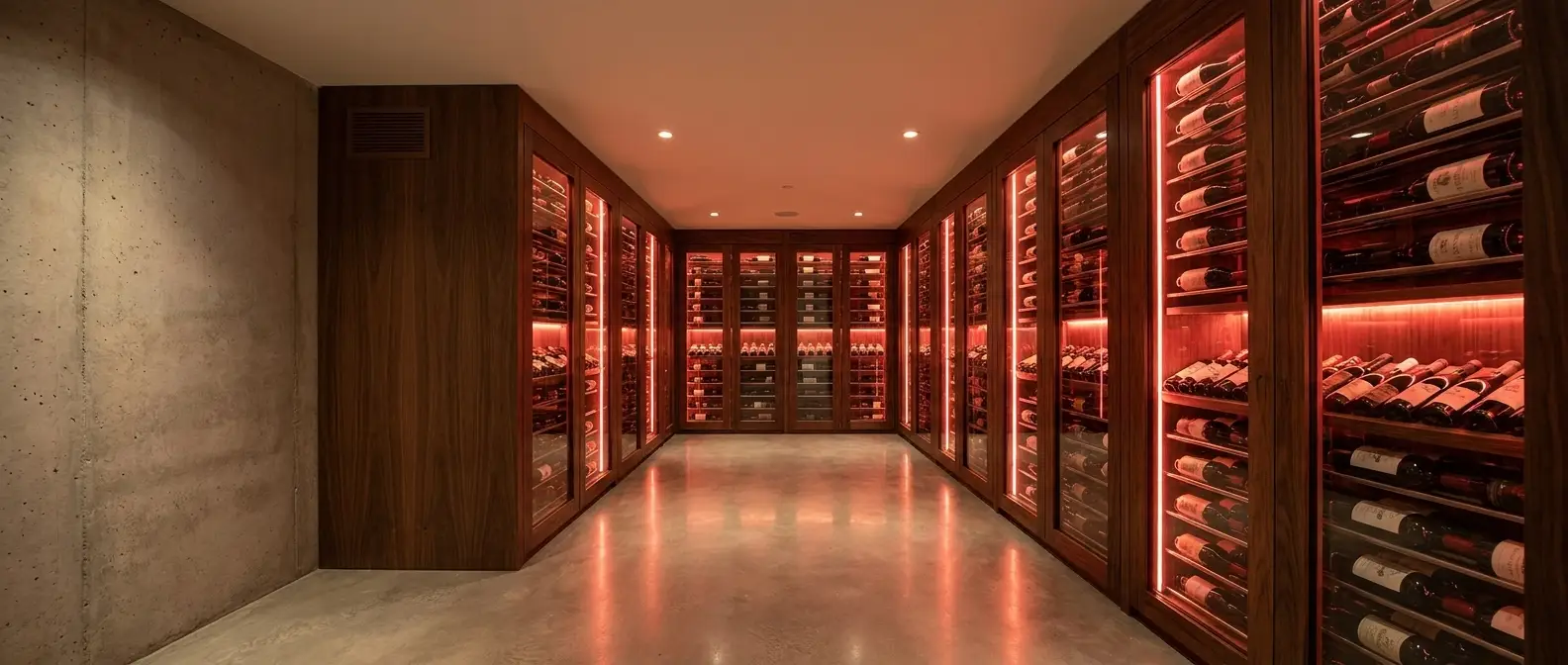
Owner checks
What you can safely check yourself
A cooling unit that is cared for lightly and regularly tends to run quietly and hold temperature. Everything below is general good practice and needs no tools beyond a vacuum, a soft brush and a flashlight. If a step is not in your unit's user manual, skip it and check the manual first.
Always switch the unit off at its control and disconnect power before you open any access panel or touch anything near the coil or drain.
Filter
If your unit has a filter, a dirty one restricts airflow, which is the most common cause of weak cooling and coil icing. Clean or replace it on the schedule in your manual.
Intake and return
Keep grilles, vents and the space around the cabinet clear of boxes, racking and dust. The unit needs to breathe in and out freely.
Condensate drain and pan
Cooling removes moisture from the air. Look for a drain line that is free-flowing, not kinked, and a pan with no standing water, slime or debris.
Setpoint and thermostat
Confirm the setpoint is where you left it. A cellar is usually held near 55 F. A reading that differs from a separate thermometer is worth a note.
Door seals and insulation
Worn door seals and gaps let warm, humid air in, so the unit runs longer. Close the door on a sheet of paper: if it slides out easily, the seal is weak.
Ducts and grilles
For a ducted system, look for loose connections, crushed duct or torn insulation. Visible condensation on a duct is a sign to have it inspected.
Your unit
What Panthaire says about APEX upkeep
Our installation guide lists a simple routine for an APEX system: clean the carbon filter every 6 months and replace it every 12 months, flush the drain line every 6 months, and inspect ducts and seals every 6 months for breaks in insulation or air leaks. It also suggests watching the cellar temperature and the control panel for diagnostic codes.
The same guide notes that APEX runs an automatic defrost cycle about every 8 hours, lasting around 60 minutes. That is expected behavior and not a fault. Other pages on our site give slightly different filter intervals, so treat your unit's user manual as the final word.
Troubleshooting
Symptom, likely cause and what to do
Start with the simplest cause in each row. Many of these resolve with a filter, a clear grille or a drain check. If the first step does not help, stop there and call a professional rather than opening the unit.
| Symptom | Likely cause | What to do |
|---|---|---|
| Not cooling enough | Dirty filter, blocked intake or return, door left open, setpoint changed, a warm mechanical space, or a heat load larger than the unit was sized for | Check the filter, clear the grilles, confirm the setpoint and door seal, and note the room temperature. If still warm after a day, call a technician. |
| Short cycling (starts and stops often) | Restricted airflow, a thermostat placed in a draft or near a vent, or an electrical or control fault | Clean the filter and clear airflow. If it keeps cycling, a technician should check the controls and electrical supply. |
| Ice on the coil or lines | Most often low airflow from a dirty filter or blocked vent. Less often a low refrigerant charge from a leak | Switch the unit off and let the ice melt fully. Clean the filter and clear airflow. If ice returns, call a technician: that points to the sealed circuit. |
| Water leak or puddle | Clogged or kinked condensate drain, a drain that does not slope, an overflowing pan, or melting ice from a frozen coil | Switch off, mop up, and check the drain line and pan. Clear a visible blockage only if your manual allows it. Call a technician for a persistent leak. |
| Noisy | Loose panel or duct, debris near a fan, a unit not level or isolated from vibration, or a failing motor or compressor | Tighten accessible panels and clear debris. A grinding, squealing or buzzing sound that continues is worth a service call. |
| Cellar too humid or condensation on surfaces | Leaking door seal or duct, an open door, or a drain that is not clearing | Check seals and the drain, and keep the door closed. A wine cellar vapor barrier problem may need a contractor. |
| Error code on the control panel | A fault the unit has detected | Look up the code in your user manual. Do not reset repeatedly. Call a technician if it returns. |
Ice
Frost, ice and a normal defrost cycle
A light frost that comes and goes during a defrost cycle is normal on many cooling units. Ice that builds up, stays after a defrost, or drips water into the room is different.
Ice forms when the coil gets colder than freezing while moist air passes over it. Reduced airflow is the usual reason, so a clean filter and open grilles are the first fix. A leak in the refrigerant circuit can produce the same ice, and that cannot be fixed at home.
If you have melted the ice, cleaned the filter, cleared the airflow and it freezes again, treat it as a service call. Running a frozen unit repeatedly can stress the compressor.
Professional help
When to call a licensed HVAC technician
Calling a professional is a normal part of owning a cooling system, and it does not mean something is badly wrong. Some work simply belongs to a licensed tradesperson.
APEX
APEX service and warranty basics
APEX units are factory-charged and sealed, so there is nothing for the owner to add to the refrigerant circuit. APEX is installed by a licensed HVAC contractor in a mechanical space kept between 50 and 77 F, and it carries a 2-year warranty. DIY installation voids that warranty, so involve your installer or Panthaire support before any repair.
Keep a short log of maintenance dates. Our warranty page lists maintenance records among the documents that support a claim.
Questions
Wine cellar cooling unit maintenance questions
How often should I maintain a wine cellar cooling unit?
Do a quick visual check every few months and the filter and drain tasks on the schedule in your manual. Panthaire's installation guide lists a 6-month routine for APEX, with the carbon filter replaced every 12 months.
Why is my wine cellar cooling unit not cooling?
Start with airflow: a dirty filter, blocked grilles, an open door or a changed setpoint. If those are fine and the cellar stays warm, call a licensed HVAC technician.
Why does my wine cooling unit turn on and off all the time?
Restricted airflow is the common cause, so clean the filter and clear the grilles. Constant short cycling can also point to a control or electrical fault that a technician should check.
Why is there ice on my wine cellar cooling unit?
Usually low airflow from a dirty filter or blocked vent. Switch the unit off, let the ice melt, fix the airflow and restart. If ice comes back, a refrigerant problem is possible and needs a technician.
Why is my wine cellar cooling unit leaking water?
The most common cause is a clogged, kinked or poorly sloped condensate drain, or a pan that is overflowing. Melting ice from a frozen coil can also look like a leak.
Can I recharge the refrigerant myself?
No. Refrigerant work belongs to a licensed technician. APEX units are factory-charged and sealed, and a low charge means there is a leak that has to be found and repaired.
Is wine cooling unit repair covered by warranty?
APEX carries a 2-year warranty with conditions, including licensed installation and the published 50 to 77 F ambient range. Read the warranty page and contact support before arranging any repair.
Is a defrost cycle normal?
Yes, on many cooling units. Panthaire's installation guide says APEX defrosts about every 8 hours for around 60 minutes, which is expected behavior and not a fault.
Next step
Not sure what you are seeing?
Check your unit's user manual first, and reach out to Panthaire support if you need help deciding the next step.