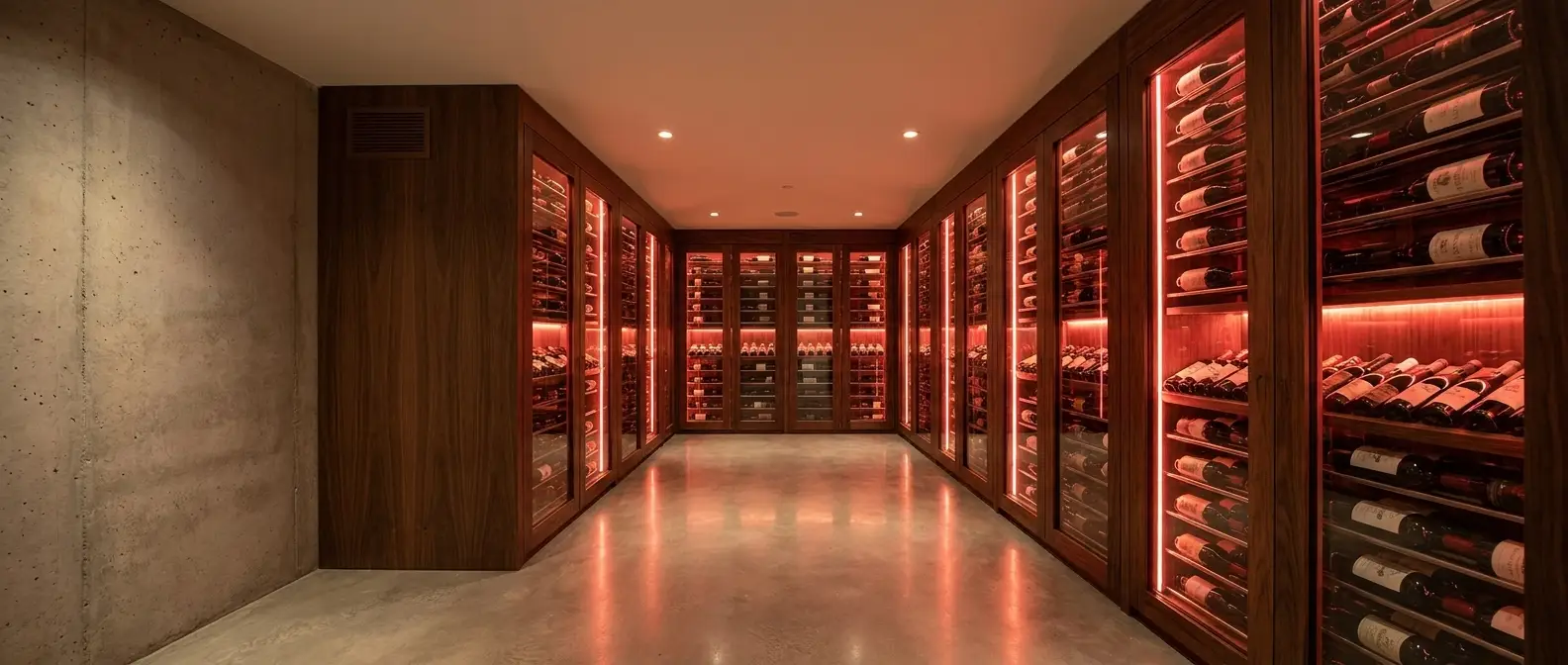
Wine Storage Guide
Wine cellar
air conditioning
The everyday term for purpose-built cellar cooling equipment that holds a sealed room near 55°F. It is not a residential A/C tuned down, and the difference is the entire reason a wine cellar needs its own machine.
Why A/C won’t work
A/C floor
Lowest setpoint residential A/C controls allow.
68°F
APEX default
Cellar target setpoint, factory-set on Panthaire APEX.
55°F
A residential air conditioner will not run below 68°F. A wine cellar needs to sit near 55°F. That 13°F gap is the zone a purpose-built cellar cooling unit is engineered to operate in, and it is the reason a standard A/C cannot serve as one.
The gap
13What is wine cellar air conditioning?
Wine cellar air conditioning is the colloquial name for purpose-built cooling equipment that holds a sealed wine storage room near 55°F (13°C) year-round. The industry calls the same equipment wine cellar refrigeration. Both terms describe a closed vapor-compression loop sized and tuned for the cellar setpoint, not for human comfort.
A residential air conditioner is a different machine for a different job. It is engineered to hold a room between 68°F and 75°F, the comfort band for people. Its controls usually refuse to run below the mid-60s, and its compressor and evaporator are sized for that envelope. When a homeowner asks whether a standard A/C can be used to cool a wine cellar, the practical answer is no. Forcing one to try produces frost on the coil, short cycling, and early compressor failure.
The room matters as much as the equipment. Insulation, vapor barrier, door sealing, glass specification, and airflow all decide whether the cooling unit can hold the setpoint with a quiet duty cycle. A correctly sized unit in a leaky room runs hot. A modestly sized unit in a sealed room quietly does its job for years.
How does wine cellar cooling differ from residential air conditioning?
Both systems use the same vapor-compression cycle, but the setpoints they target, the controls that govern them, and the duty cycles they are built for are different. A purpose-built wine cellar cooling unit is closer in design philosophy to a household refrigerator than to a residential A/C.
| Attribute | Wine cellar cooling | Residential A/C |
|---|---|---|
| Target temperature | 55°F (13°C), held steady year-round | 68°F to 75°F (20°C to 24°C), for human comfort |
| Operating range | 50°F to 70°F, full supported envelope | Typically 68°F floor; lower setpoints refused by controls |
| Setpoint stability | ±2°C factory-locked differential on APEX | Several degrees swing on either side of the setpoint |
| Duty cycle | Designed for continuous low-load operation | Designed for variable load with cooling spikes |
| Defrost | Automatic defrost cycle, expected at low setpoints | No defrost; running below freezing risks coil damage |
| Warranty alignment | Panthaire APEX: 2-year residential parts and labor coverage | Voided if used to cool a wine cellar (off-label use) |
Four reasons a standard air conditioner cannot cool a wine cellar
Each failure mode below is enough on its own to disqualify a residential A/C from cellar service. Together they explain why purpose-built equipment exists at all.
The setpoint floor is too high
Controls refuse to run below 68°FMost residential A/C controls refuse to take a setpoint below 68°F. A wine cellar needs to sit near 55°F. The controls were never designed to go that low, so the unit either refuses to engage or runs at its lowest legal setpoint and never reaches the cellar target.
The swings are too wide
±3°F drift on either side of setpointResidential A/C controls aim for human comfort, where a 3°F swing on either side of the setpoint is invisible. In a wine cellar that swing is the entire margin. Wine ages on a flat curve when the temperature is held steady, and it ages unpredictably when the temperature moves several degrees per cycle.
Frost and short cycling damage the coil
Evaporator coil drops below freezingWhen a standard A/C is forced toward 55°F, the evaporator coil drops below freezing and ice forms. The unit short-cycles trying to manage the situation, and over time the coil deforms, the compressor wears out, and refrigerant charge drifts. Purpose-built cellar units include an automatic defrost cycle to prevent this exact failure mode.
The duty cycle does not match the load
Compressor sized for variable load, not steady low loadA residential A/C is engineered for variable load with spikes during hot afternoons. A wine cellar is the opposite: a steady, low-grade heat load through a sealed envelope. The compressor on a residential A/C is sized to push hard for short periods, not to hum quietly for hours. Running it in cellar service shortens its life and voids its warranty as off-label use.
What does “purpose-built” wine cellar air conditioning actually mean?
Purpose-built is a marketing phrase until the engineering choices behind it are spelled out. For a wine cellar cooling unit, the purpose-built parts are the operating range, the differential, the defrost cycle, and where the temperature is read. Together they make the unit suitable for cellar service. Without them it is a household A/C with a sticker.
Cellar-tuned operating range
50°F to 70°F supported envelope, with 55°F as the standard storage target. The compressor, evaporator, and controls were sized for that band from the start.
Tight factory-locked differential
±2°C on Panthaire APEX, set at the factory and not user-adjustable. Tight differential keeps the cellar steady and protects the compressor from short cycling.
Automatic defrost cycle
Auto defrost runs every 8 hours and lasts about 60 minutes. Without it the evaporator coil would freeze over within days of continuous low-temperature operation.
Return-air temperature sensor
The cellar temperature is read in the unit's return air stream, not from a wall-mounted device in the room. The control panel reacts to actual cellar conditions, not to a draft against a wall sensor.
On the control panel terminology
The APEX control panel is a digital interface, not a wall thermostat. It lives on the unit itself, reads cellar temperature from a return air sensor inside the cabinet, and exposes setpoint, fan mode, and diagnostic codes. The default ship state is 55°F with fan on Auto. There is no app, no Wi-Fi pairing, and no integration with home automation platforms. The interface is intentionally simple because most cellars need to be set up once and left alone.
How is Panthaire APEX engineered for wine cellar service?
Panthaire APEX is a ducted residential wine cellar cooling system. The cabinet sits outside the finished cellar, conditioned air moves through insulated supply and return ducts, and the cellar interior stays clean. Capacities below are rated for a sealed cellar with R-20 insulation and dual-pane Low-E glass.
Ducted architecture
Cabinet lives outside the finished cellar. Insulated supply and return ducts move conditioned air to and from the room. The cellar interior stays free of visible mechanical hardware.
Dedicated 115V circuit
115V / 60Hz, dedicated circuit required. 15A for APEX 3500 and APEX 5000, 20A for APEX 7000. Shared circuits cause trip events and warranty disputes.
Ambient air management
Condenser ambient air must stay between 50°F and 77°F (10°C to 25°C). Outside that band the unit cannot reject heat correctly.
Licensed HVAC installation
Installation by a licensed HVAC professional is required. DIY installation or use of non-insulated ducting voids the warranty.

APEX sizing at a glance
Three models cover most residential cellars. Capacities assume a properly built envelope. Glass exposure, room ambient, and door use all shift the right model up or down.
Wine cellar air conditioning FAQ
Tap a question to expand the answer.
No. Residential air conditioners are designed for human comfort, typically 68°F to 75°F. They cannot hold a setpoint at 55°F because their controls and compressor operating envelope are not engineered to run that low. Forcing one to try usually leads to short cycling, frost on the evaporator coil, and early compressor failure. Purpose-built wine cellar cooling units operate in the 50°F to 70°F range with controls designed for that band.
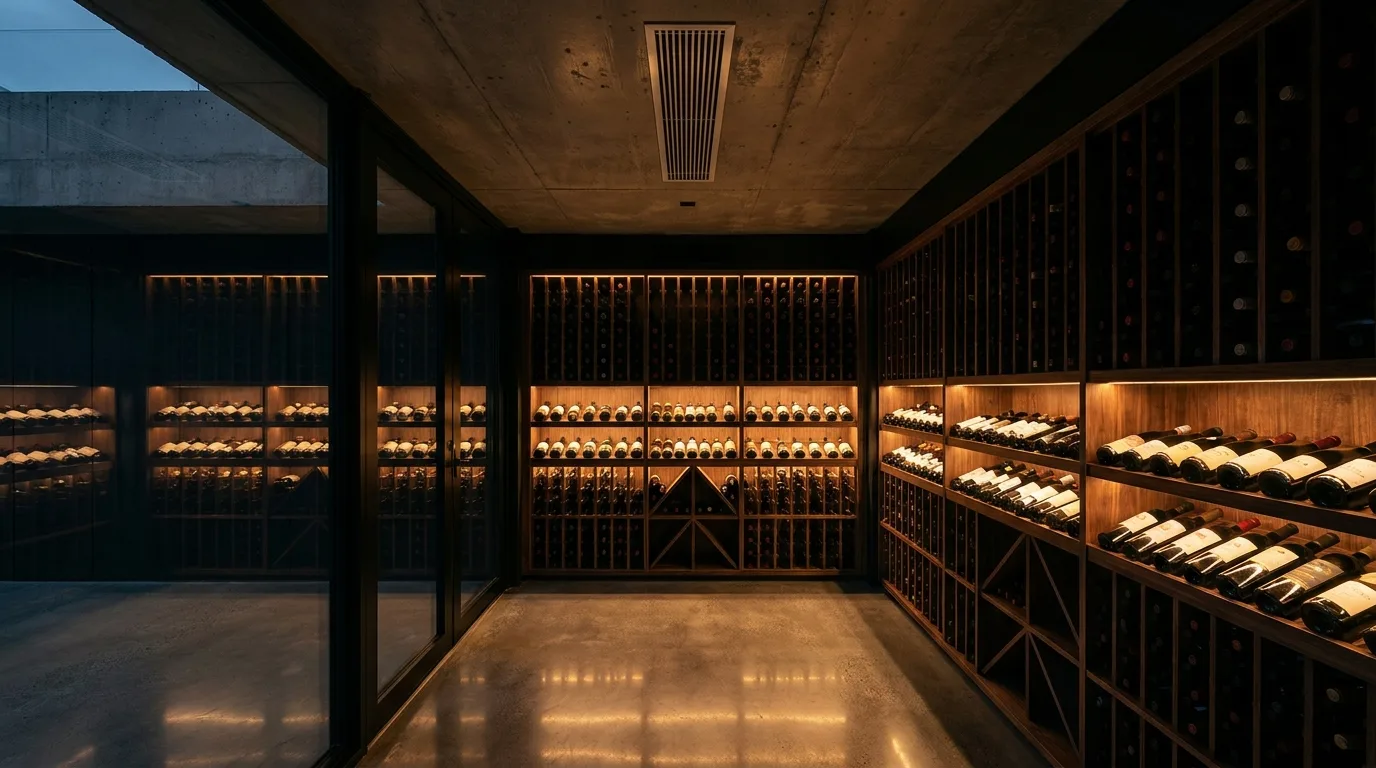
Next step
Size the cooling, not the air conditioner
Start with the cooling load. The BTU calculator accounts for cellar volume, glass exposure, door use, and ambient conditions, then points you toward the right APEX model.