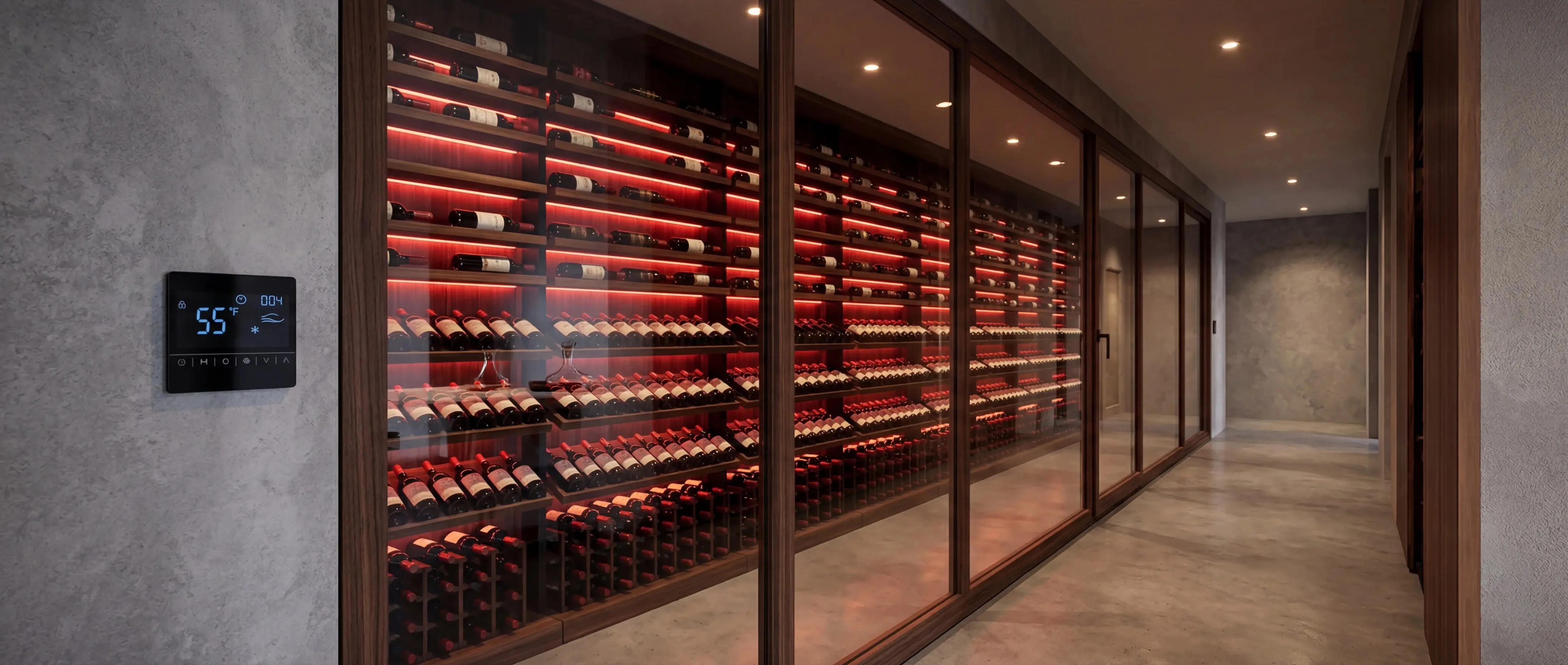
Wine Cellar Cooling Guide
Wine Cellar Cooling Unit
Everything you need to choose, size, and install the right cooling unit for your wine cellar. Compare the four system types, run the BTU calculator on your specific room, and shop the Panthaire APEX series. Built for serious cellars, shipped sealed, installed by licensed HVAC professionals.
What is a wine cellar cooling unit?
A wine cellar cooling unit is a purpose-built refrigeration system designed to hold a steady 55°F (13°C) at 50-70% humidity inside a dedicated wine storage room, typically year-round, with minimal temperature swing. It looks like a small HVAC unit and uses the same basic refrigeration cycle, but the engineering target is different.
A residential air conditioner is built for human comfort: it cycles on, drops the room temperature several degrees, and shuts off. A wine cellar cooling unit runs continuously at low duty cycle to hold a much narrower temperature band, with humidity preservation to prevent corks from drying out. Running a regular AC in a cellar will short-cycle, condense excessive water out of the air, and burn out the compressor within a few seasons.
Cooling units come in four installation types: through-wall, self-contained, split, and ducted. Each is covered in detail below. The right choice depends on cellar size, where the equipment can live, and how visible the install is allowed to be.
Why ducted
For most installations, ducted is the only correct answer. The wine cellar cooling industry has accepted in-room compressors as a default for decades because installers prefer the easier job. The result: collectors live with mechanical noise inside the very room built to be a sanctuary.
Ducted reverses this trade-off. The equipment lives elsewhere. The cellar stays silent.
The four types of wine cellar cooling units
Every wine cellar cooling unit on the market falls into one of four installation categories. Each trades off cost, noise, and install complexity differently. There's no single best option, only the right fit for your room and budget.
Through-wall
- BTU range
- 1,000-3,500 BTU
- Noise
- Loud (in-room)
- Install
- DIY-feasible
- Best for
- Closets and small wine walls under 200 ft³
Self-contained
- BTU range
- 1,500-5,500 BTU
- Noise
- Moderate (in-room)
- Install
- Pro recommended
- Best for
- Mid-size cellars where through-wall isn't practical
Split
- BTU range
- 3,000-12,000 BTU
- Noise
- Quiet (compressor outside)
- Install
- Licensed HVAC required
- Best for
- Large cellars or installs needing remote condenser
Ducted (APEX)
- BTU range
- 3,353-6,346 BTU
- Noise
- Whisper-quiet (equipment in another room)
- Install
- Licensed HVAC required
- Best for
- Architecturally clean installs of any size
| Type | BTU range | Noise | Install | Best for |
|---|---|---|---|---|
| Through-wall | 1,000-3,500 BTU | Loud (in-room) | DIY-feasible | Closets and small wine walls under 200 ft³ |
| Self-contained | 1,500-5,500 BTU | Moderate (in-room) | Pro recommended | Mid-size cellars where through-wall isn't practical |
| Split | 3,000-12,000 BTU | Quiet (compressor outside) | Licensed HVAC required | Large cellars or installs needing remote condenser |
| Ducted (APEX) | 3,353-6,346 BTU | Whisper-quiet (equipment in another room) | Licensed HVAC required | Architecturally clean installs of any size |
Through-wall and self-contained
All-in-one boxes that mount in or against the cellar wall. Lowest install cost but the compressor lives in the cellar, so expect audible operation and visible equipment. Best for compact cellars under 200 ft³ where serviceability matters more than architectural integration.
Split systems
Compressor outside, evaporator inside, refrigerant lines connect the two. Quiet inside the cellar, but installation requires a licensed HVAC technician for the refrigerant work. Good middle ground for larger cellars.
Ducted (Panthaire APEX)
The cooling unit sits in another room (basement, attic, or mechanical closet) and conditioned air flows in via insulated ductwork. Nothing visible inside the cellar except supply and return grilles. Quietest option, cleanest aesthetics, no refrigerant lines through finished walls.
How we built APEX
APEX is a fully ducted system because that is what serious cellars require. Three models, APEX 3500, APEX 5000 and APEX 7000, cover cellars from compact wine walls to 2,000 ft³ rooms in a single ducted architecture. Each unit ships pre-charged and sealed. No field refrigerant work.
Size your wine cellar cooling unit
Sketch your cellar floor plan below. We'll compute the volume, factor in glass surface and door openings, and recommend the APEX model that fits, using the same BTU formula our engineers use for commercial sizing quotes.
Hide manual entry

APEX sizing at a glance
The calculator above gives the most accurate match. For a quick eyeball: pick the APEX model whose volume range covers your cellar with insulation already accounted for (R-20 walls / R-30 ceiling baseline).
Up to 900 ft³
APEX 3500
3,353 BTU · R-290
Shop 3500900-1,200 ft³
APEX 5000
4,462 BTU · R-290
Shop 50001,200-2,000 ft³
APEX 7000
6,346 BTU · R-290
Shop 7000| Cellar volume | Refrigerant | Recommended model | BTU | Shop |
|---|---|---|---|---|
| Up to 900 ft³ | R-290 | APEX 3500 cooling unit | 3,353 BTU | Shop 3500 |
| 900-1,200 ft³ | R-290 | the APEX 5000 wine cellar cooling unit | 4,462 BTU | Shop 5000 |
| 1,200-2,000 ft³ | R-290 | high-capacity APEX 7000 | 6,346 BTU | Shop 7000 |
Installation considerations
A wine cellar cooling unit is only as good as its installation. Plan for these four things before ordering. Each one trips up a meaningful share of warranty disputes when skipped.
Electrical
APEX 3500 and APEX 5000 require a dedicated 115V / 60Hz, 15A circuit. APEX 7000 requires a dedicated 115V / 60Hz, 20A circuit. All three need proper grounding. Sharing the circuit with other appliances will trip the breaker under summer load.
Ductwork
Supply and return ducts must be sized to the unit's airflow spec, kept under 25 ft total run, and insulated where they pass through unconditioned space. Our ductwork guide covers sizing and routing.
Cellar build
R-20 walls / R-30 ceiling minimum, with a sealed vapor barrier on the warm side. Without it, condensation forms inside the wall cavity. See our modern and traditional cellar guides.
Professional install
Ducted systems should be installed by a licensed HVAC contractor. DIY installs are the leading cause of warranty disputes. APEX ships pre-charged with no field refrigerant work, but circuit, ducting, drain, and thermostat all need a qualified pair of hands.
Common mistakes to avoid
The four mistakes that cause the most warranty disputes and underperforming installs.
Undersizing the unit
The single most common mistake. An undersized unit runs continuously, never holds setpoint in summer, and burns out in 3-5 years instead of 10-15. When in doubt, size up.
Skipping the vapor barrier
Without a vapor barrier on the warm side of the wall, water vapor migrates through the insulation and condenses inside the cavity. The cellar feels cold while moisture accumulates inside the wall cavity, which leads to long-term structural damage.
Ignoring glass surface area
Glass conducts heat ~10x faster than insulated wall. A glass-walled cellar can need 50-100% more BTU than the volume alone suggests. The calculator above factors this in; spec-by-volume tables don't.
Wrong drain location
The condensate drain must be pitched continuously toward an actual drain, gravity only. A flat or back-pitched drain line backs up, overflows, and damages the cellar floor.
Wine cellar cooling unit FAQ
Tap a question to expand the answer.
A wine cellar cooling unit is engineered to hold a stable 55°F (13°C) at 50-70% humidity for years of continuous operation, while a residential AC is designed for human comfort (68-78°F) and short cycling. Wine cellar units have stronger compressors for sustained low-temp duty, lower minimum temperature limits, and humidity preservation logic that prevents the corks from drying out. Running a regular AC in a wine cellar will short-cycle, produce excessive condensation, and likely fail within a few seasons.
For the trade
Architects, designers, and contractors
APEX is specified into custom cellars by a growing roster of design and build firms. Three things we offer trade partners:
Spec sheets and drawings
Cut sheets, dimensions, BTU curves, ductwork diagrams, and clearance requirements available for every APEX model.
Install support
Direct line to our engineering team for sizing review, ductwork routing, and pre-install checks on active projects.
Trade pricing program
Project pricing for licensed contractors, designers, and architects on qualifying volume.
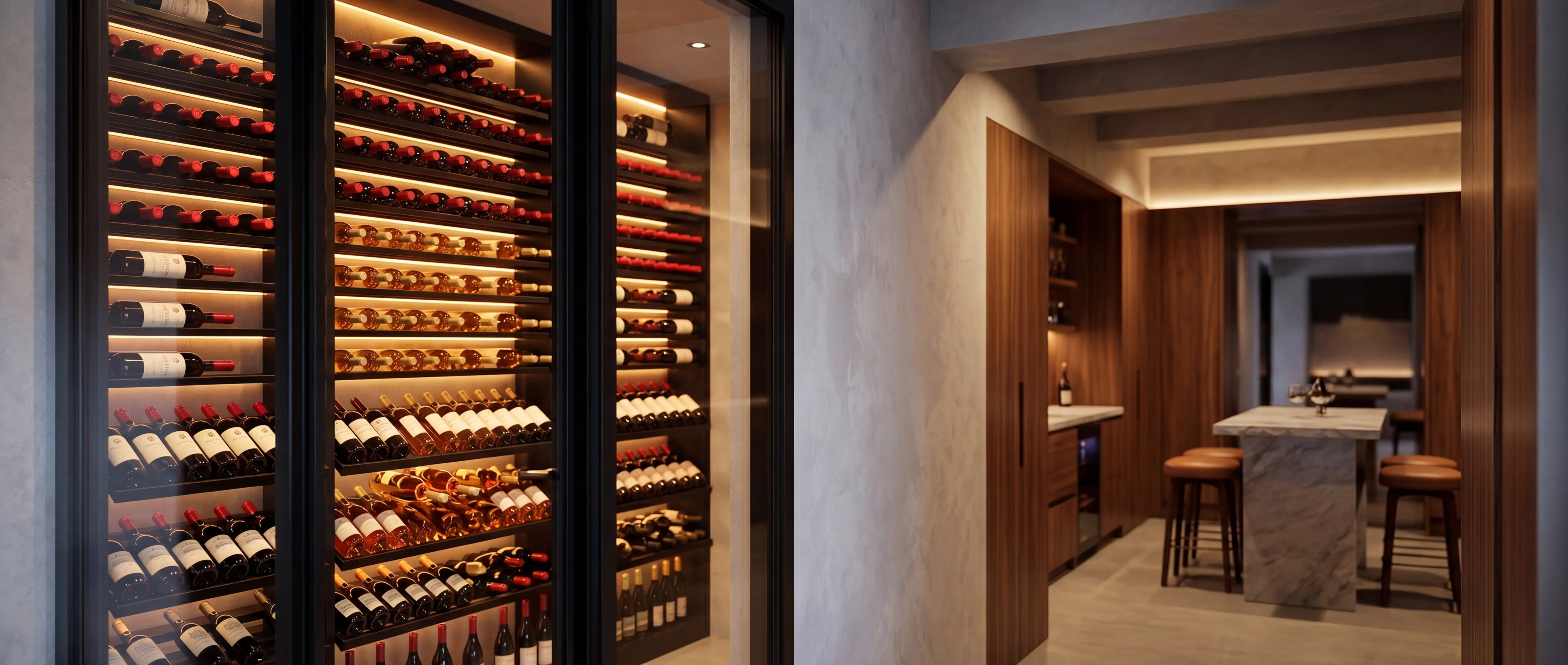
Ready to choose your APEX
Three sizes. One ducted architecture. Pre-charged from the factory and shipped direct across the United States with a 2-year warranty.