Wine Storage Guide
Wine cellar
refrigeration
Wine cellar refrigeration is the equipment, controls, and room design that hold a cellar steady near 55°F for long-term storage. This guide explains the refrigeration cycle, the difference between residential and commercial systems, how Panthaire APEX compares, and what installation actually requires.
Condenser ambient range
The air around the condenser must stay between 50°F and 77°F (10–25°C). Outside that range a refrigeration unit cannot reject heat correctly.
Cellar setpoint
55°F
13°C, the standard storage target
Operating range
50–70°F
APEX supported cellar range
Differential
±2°C
Factory-locked, prevents short cycling
Refrigerant
R290
From July 2025 onward (was R134a)
The short answer
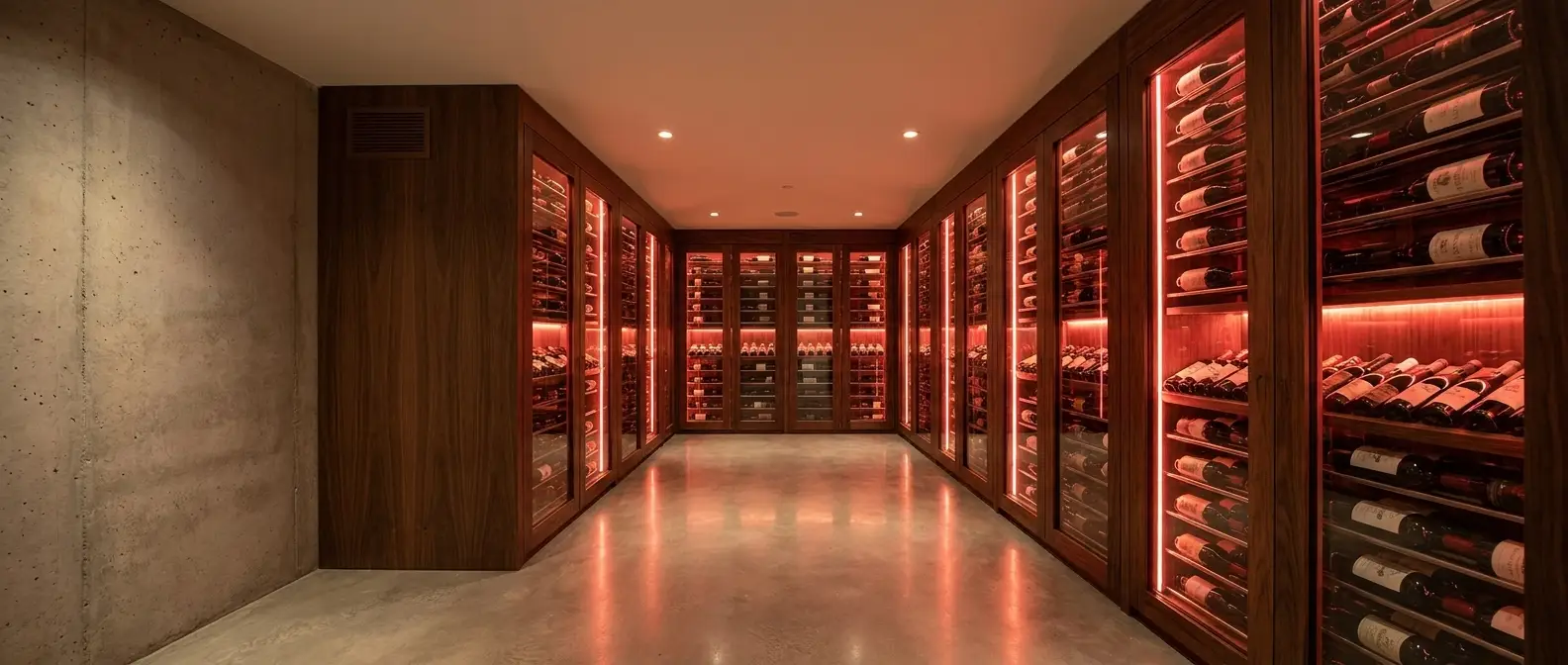
Wine cellar refrigeration is purpose-built cooling equipment for a sealed wine storage room. It is not a kitchen refrigerator scaled up, and it is not a standard air conditioner tuned down. The equipment, controls, and operating range are engineered for a small, well-insulated room held near 55°F (13°C) year-round.
A wine cellar refrigeration system has three jobs. Hold the setpoint within a narrow band so wine ages on a predictable curve. Stay quiet enough that the cellar can sit next to living space. Run reliably for years with minimal touch from the owner. A standard air conditioner does none of these well because it is designed for a different temperature range and a different duty cycle.
The room matters as much as the equipment. Insulation, vapor barrier, door sealing, glass specification, and airflow all decide whether the refrigeration unit can hold the setpoint. A correctly sized unit in a leaky room will struggle. A modestly sized unit in a well-built room will quietly do its job for years.
Residential vs commercial wine cellar refrigeration
Both serve the same goal of steady storage near 55°F, but the duty cycle, sizing approach, and warranty terms differ. Panthaire APEX is engineered for residential cellars. Restaurants, wine bars, and retail rooms need engineered commercial systems instead.
| Attribute | Residential | Commercial |
|---|---|---|
| Typical room size | 200–2,000 ft³, one cellar door | Often larger, multiple zones, retail or restaurant traffic |
| Door openings | A few times per day | Frequent, with heat-load spikes through service hours |
| Lighting load | Display lighting kept low | Often brighter, with accent fixtures and signage |
| Operating hours | 24/7 at a quiet duty cycle | 24/7 with peak demand during service |
| Warranty coverage | Panthaire APEX: 2-year residential parts and labor coverage | APEX commercial use voids the residential warranty |
| Sizing approach | BTU calculator + glass and ambient factors | Engineered design including peak-hour load |
How a wine cellar refrigeration cycle works
Wine cellar refrigeration uses the same closed-loop vapor-compression cycle as a household refrigerator, sized and tuned for the cellar setpoint. A return air sensor reads cellar temperature inside the unit. The control panel commands the compressor to start when the room drifts above the band, and to stop once the room is back inside it.
1. Compressor
Raises refrigerant pressure and temperature so heat can leave the loop. This is the loudest component and the reason ducted architectures place it outside the finished cellar.
2. Condenser
Releases heat to ambient air outside the cellar. The condenser needs ambient air between 50°F and 77°F to reject heat correctly.
3. Expansion device
Drops the pressure suddenly. The refrigerant cools as it expands, ready to absorb heat from the cellar air.
4. Evaporator
Absorbs heat from cellar air as the refrigerant boils. A blower moves cellar air across the coil and returns conditioned air to the room.
Defrost cycle
A wine cellar refrigeration unit runs an automatic defrost cycle to clear frost from the evaporator coil. On Panthaire APEX, defrost runs every 8 hours and lasts about 60 minutes. During defrost the room may rise slightly above setpoint, then return as normal cooling resumes. This is expected behavior, not a fault.
Wine cellar refrigeration architectures
Three architectures show up across residential wine cellar refrigeration: through-the-wall, split, and ducted. Each handles the same refrigeration cycle differently, with consequences for noise, cellar aesthetics, install complexity, and where the heat goes.
Through-the-wall
A self-contained unit installed through a wall, drawing return air from the cellar and exhausting heat to an adjoining space. Lowest install cost. Best for small to mid-size cellars with a suitable adjoining room for heat rejection.
Split system
The condenser sits separately from the evaporator, connected by refrigerant lines. Allows the condenser to live outside or in a mechanical space. Quieter inside the cellar than a self-contained unit.
Ducted
The unit lives in a mechanical room or attic, and supply and return ducts move air to and from the cellar. The cellar interior stays clean, with no visible equipment. Best for glass-fronted cellars, larger rooms, and homes where the cellar is part of finished living space. Panthaire APEX is a ducted architecture.
Panthaire APEX refrigerant
R134a → R290
Units manufactured before June 2025 use R134a. Units from July 2025 onward use R290, a hydrocarbon refrigerant with a much lower global warming potential.
Refrigerants in wine cellar refrigeration
The refrigerant inside a wine cellar refrigeration unit is sealed in a closed loop and never touched by the homeowner. What changes from generation to generation is the chemistry itself, driven by tightening environmental rules around global warming potential and ozone depletion.
Panthaire APEX units shipped before June 2025 use R134a, an HFC refrigerant common across residential refrigeration for the last two decades. From July 2025 onward, APEX units ship with R290, a hydrocarbon refrigerant with dramatically lower global warming potential. The cellar setpoint, operating range, differential, and warranty terms are the same on both.
The refrigerant should only be serviced by a licensed HVAC professional. Repairs or refrigerant work attempted by anyone else can release refrigerant into the environment, damage the sealed loop, and void warranty coverage.
How Panthaire APEX wine cellar refrigeration compares
Panthaire APEX is a ducted residential wine cellar refrigeration system. The equipment lives outside the finished cellar, conditioned air moves through supply and return ducts, and the cellar interior stays free of visible mechanical hardware. Capacities below are rated under a sealed cellar with R-20 insulation and dual-pane Low-E glass.
Cellar range
Holds the cellar between 50°F and 70°F. Setpoint near 55°F for mixed storage.
Locked differential
±2°C factory-locked operating band prevents short cycling and protects the compressor.
Electrical
115V / 60Hz dedicated circuit. 15A for APEX 3500 and 5000, 20A for APEX 7000.
Installation
Must be installed by a licensed HVAC professional. DIY installation voids the warranty.
APEX sizing at a glance
Three models cover most residential cellars. Capacities assume a properly built envelope. Glass exposure, room ambient, and door use all shift the right model up or down.
Wine cellar refrigeration FAQ
Tap a question to expand the answer.
Wine cellar refrigeration is the equipment and design that holds a dedicated wine room near 55°F (13°C) year-round, with stable conditions for long-term storage. Unlike a kitchen refrigerator or a standard air conditioner, a wine cellar refrigeration system is engineered for the lower setpoint, the small operating differential, and the heat load of a sealed cellar enclosure with insulation, vapor barrier, and often glass exposure.
Next step
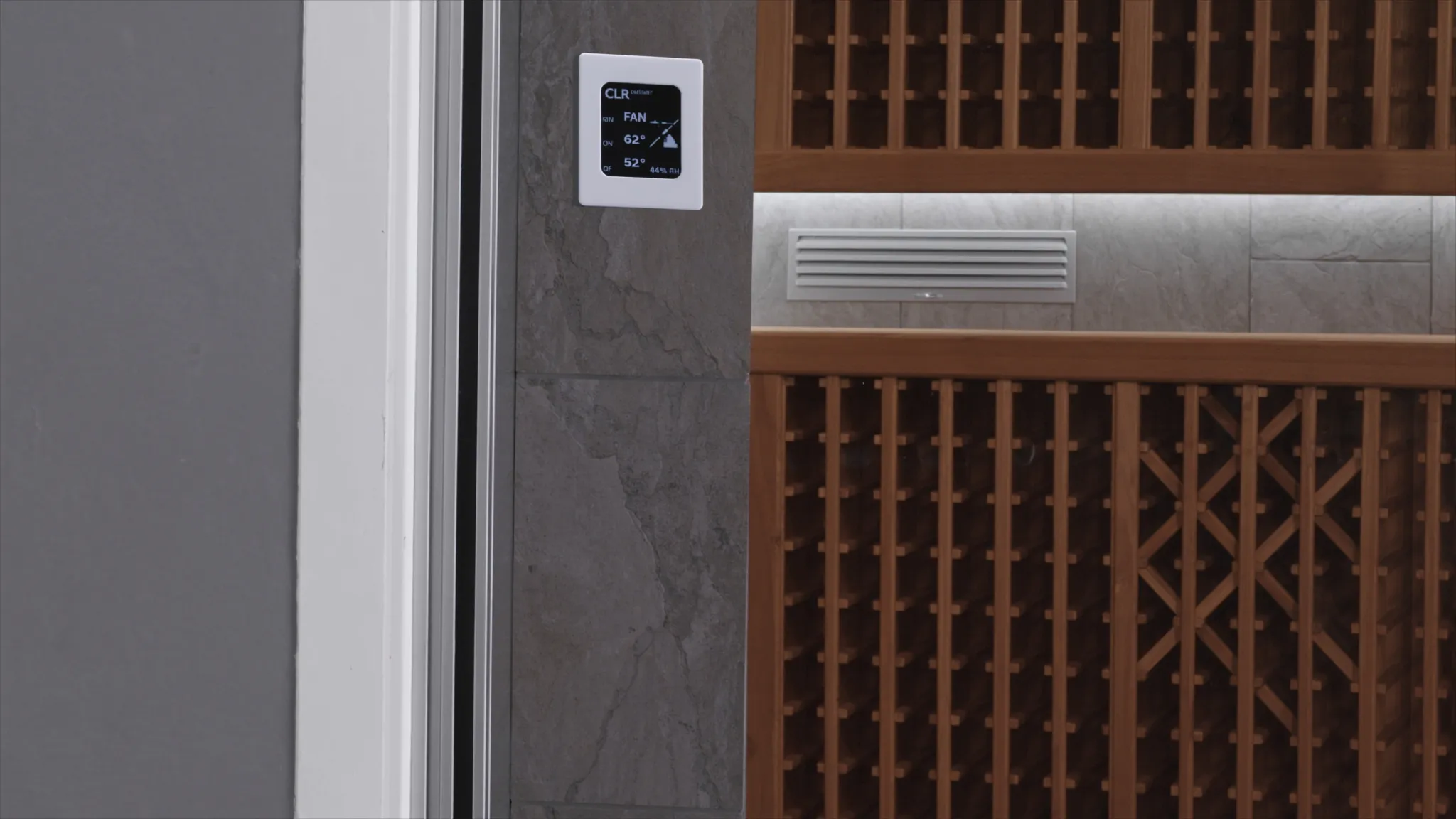
Size the refrigeration, not just the room
Start with the cooling load. The BTU calculator accounts for volume, glass exposure, door use, and ambient conditions, then points you toward the right APEX model.