April 30, 2026
Wine Cellar Cooling Unit Buyer's Guide: Types, Sizing, and What to Choose
How to choose a wine cellar cooling unit: the four system types compared, accurate sizing for your cellar, common installation mistakes, and what type fits which use case.
Written and reviewed by
Panthaire HVAC Engineering Team · Licensed HVAC · Wine Cellar Cooling Specialists
The team that engineers APEX is the same team that ships it and answers the phone when installers call.
Last reviewed · July 2, 2026
Reading time
5 min
~1,065 words
Key takeaways
- A wine cellar cooling unit holds the room in a stable band around 55°F on low airflow and a tight differential. A standard air conditioner can't do that.
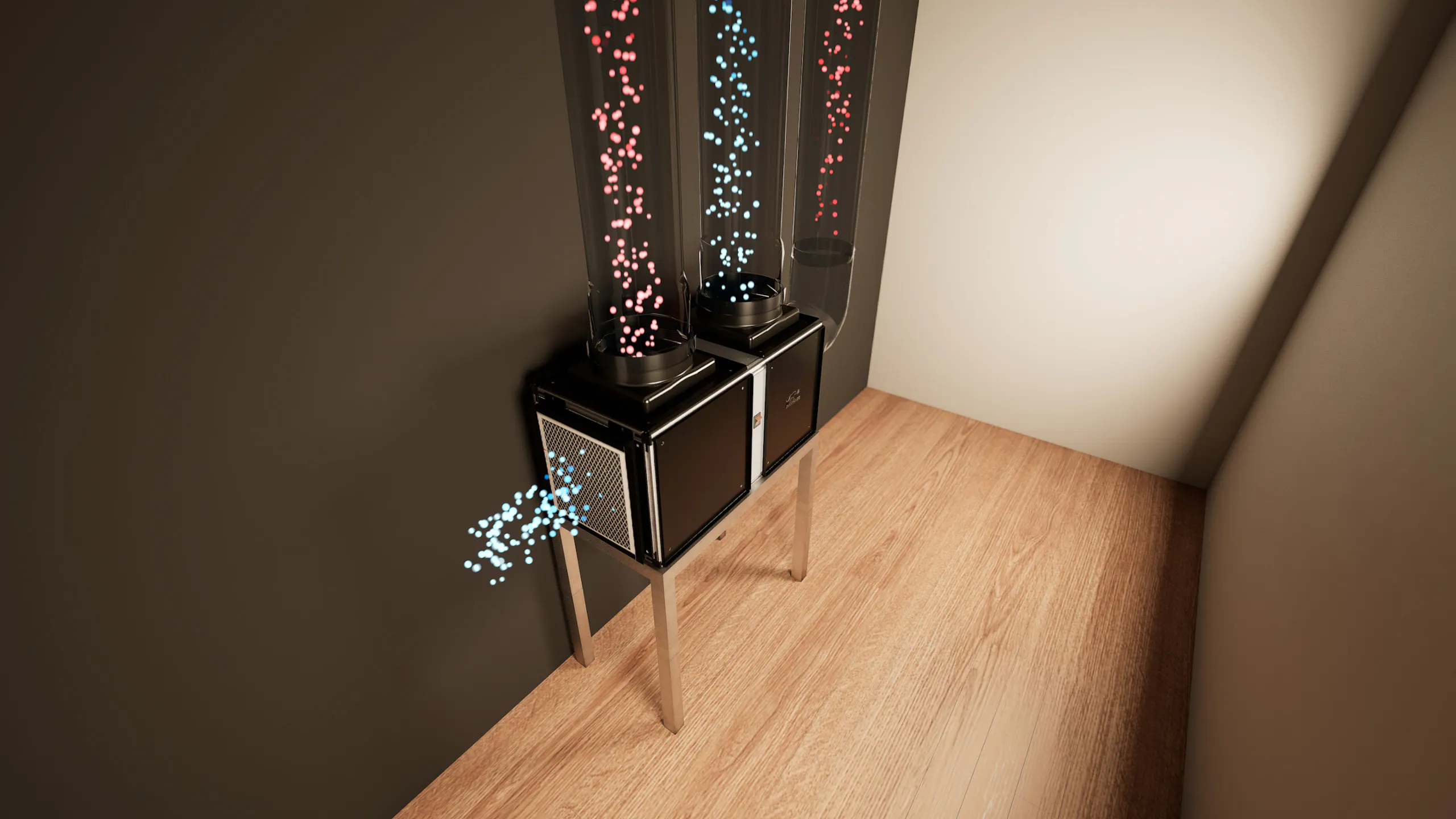
- Four architectures cover the category: through-wall self-contained, ductless split, ducted split, and self-contained ducted (Panthaire APEX). Ducted keeps all the equipment and noise out of the cellar.
- Size by cubic footage and insulation grade, then add about 15% for heavy glazing. Undersizing runs the compressor nonstop and oversizing short-cycles it, so match the load with a small margin.
- APEX covers cellars up to 900 ft³ (3500), 1,200 ft³ (5000), and 2,000 ft³ (7000). The Panthaire BTU calculator returns a specific number for your build.
- The condenser needs 50 to 77°F ambient air year-round. Garages, uninsulated attics, and crawlspaces rule out a location no matter the BTU sizing.
- Split and ducted systems need a licensed HVAC professional. The APEX ships factory-sealed with a 2-year warranty, and DIY installation voids it.
Sizing a wine cellar? Get the right APEX unit for your room in two minutes.
Free BTU calculatorIf you've started shopping for a wine cellar cooling unit, you've probably noticed the category is more confusing than it should be. There are at least four different system types, sizing recommendations vary by 30-50% depending on which calculator you use, and most product pages assume you already know exactly what you want.
Here's what's actually going on under each of those system types, what to look for when sizing, and which type fits which kind of cellar.
What a wine cellar cooling unit actually does
A wine cellar cooling unit is a refrigeration system designed for storing wine, not for cooling rooms generally. The differences from a regular air conditioner matter:
- Maintains a tight temperature setpoint, typically 55°F (13°C), with minimal variation.
- Preserves humidity rather than stripping it out the way most AC units do — corks need 50-70% relative humidity to stay sealed.
- Built for continuous duty at low ambient temperatures (most window AC units stop working efficiently below ~65°F outdoor temp).
- Vibration-isolated and quiet, since wine is sensitive to vibration over long aging periods.
The single biggest difference from a hardware-store AC unit is the humidity behavior. A standard 5,000-BTU window unit running 24/7 will dehumidify your cellar to ~30% relative humidity within weeks. Corks shrink, wine oxidizes, and your collection ages decades faster than it should.
The four types of wine cellar cooling units
Most wine cellar cooling units fall into one of four categories. Each suits a different cellar size, install context, and budget.
Through-the-wall units mount in a cutout in the cellar wall, with the cold side facing the cellar and the hot side venting into an adjacent room. They're the cheapest to install and the simplest to spec, but the compressor sits inside (or right against) the cellar — so you hear it running, and you need a non-cellar room next door to dump heat into. Best for budget-conscious builds in unfinished basements.
Self-contained units sit entirely inside the cellar with a single exhaust line venting heat outward. They're popular for retrofits and small cellars where cutting through a wall isn't practical. The trade-off: the entire mechanical system (compressor, fans, condenser) lives in the cellar with your wine, which means continuous low-level noise inside the room.
Split systems separate the indoor (evaporator) and outdoor (condenser) units, connected by refrigerant lines. Familiar to anyone who's installed a residential mini-split. They're quieter than through-wall units because the compressor lives outside, but the indoor unit is still visible inside the cellar — a wall-mounted box with a face grille. Solid middle-ground option.
Ducted systems put the entire cooling unit outside the cellar (mechanical room, attic, garage, outdoor enclosure) and connect to the cellar via two insulated air ducts: one supply, one return. The cellar contains nothing but two grilles, usually concealed in the ceiling or behind millwork. The quietest of the four by a wide margin, with no visible mechanical equipment in the room. Also the most expensive.
We've written a deeper guide on how ducted wine cellar cooling works if you want the full breakdown of why this type is quieter and what it takes to install one.
How to size a wine cellar cooling unit
Cellar volume is the starting point. Multiply length × width × height (in feet) to get cubic feet. Then apply a base BTU/h estimate per cubic foot:
- Well-insulated cellar (R-19 walls, R-30 ceiling, no glass): roughly 4 BTU/h per cubic foot
- Standard insulation (R-13 walls, R-19 ceiling, no glass): roughly 6 BTU/h per cubic foot
- Glass-front cellar or wine wall: 1.5-2× the base estimate, depending on glass percentage
- Climate modifier: add 20-30% if your home is in a hot climate (Sun Belt, desert Southwest)
- Ambient modifier: add 10-15% if the cellar's adjacent rooms typically run above 75°F
A reasonable Panthaire APEX sizing reference for typical US residential cellars:
- APEX 3500 (3,353 BTU/hr) — up to ~900 cu ft (≈ 25 m³)
- APEX 5000 (4,462 BTU/hr) — up to ~1,200 cu ft (≈ 34 m³)
- APEX 7000 (6,346 BTU/hr) — up to ~2,000 cu ft (≈ 57 m³)
These assume well-insulated cellars at typical US ambient conditions. Glass-fronted or partially-insulated cellars usually need the next size up.
Common installation mistakes
Three sizing or install mistakes account for most cellar cooling failures.
Undersized unit. The most common error. A unit that runs continuously will struggle to maintain humidity (it's effectively a dehumidifier when it can't cycle off) and will wear out years faster than designed. When in doubt, size up one tier — the next-larger unit cycles less, costs less to run, and lasts longer.
Heat exhausted into the wrong space. Through-wall and self-contained units need somewhere to dump heat. Venting into a tightly-sealed laundry room or HVAC closet creates a hot pocket that re-enters the cellar through walls or under doors. Choose adjacent rooms with their own air exchange.
Unsealed ductwork on ducted systems. Insulated round duct must be sealed at every joint with foil tape or mastic, not vinyl tape (vinyl tape fails within months). Unsealed joints mean condensation in your ceiling cavity and a unit that loses 20-30% of capacity to leakage.
Which type should you choose?
A practical decision framework:
Choose ducted if your cellar is part of a finished, lived-in space (basement bar, glass-walled feature wall, dining room cellar) AND you have access to a mechanical room, attic, or basement utility space within 25 feet of the cellar.
Choose split if you can mount the condenser outside the home and you're OK with a visible indoor unit on the cellar wall. Good fit for converted closets and small dedicated rooms.
Choose self-contained if your cellar is a cabinet or closet under 100 cubic feet and you can vent the exhaust into an adjacent space. Avoid this for finished living-space cellars — the noise is meaningfully present.
Choose through-the-wall if your cellar is in an unfinished basement, you have a non-cellar room next door to accept heat, and your priority is cost over aesthetics.
Ready to choose a wine cellar cooling unit?
If your cellar fits the use case for ducted cooling (finished space, mechanical room within 25 feet, prioritizing aesthetics and quiet), the Panthaire APEX series is a fully ducted system built for residential wine cellars. Three models cover cellars from ~900 to ~2,000 cubic feet.
Browse the APEX Series, or read the installation guide and ductwork sizing guide before specifying.
Frequently asked questions
The answers below reflect the current APEX manual, the Panthaire team’s twenty-year field experience with ducted wine cellar cooling, and the sizing methodology used in our BTU calculator. The full author band with reviewer credentials sits at the top of the article.
- Which type of wine cellar cooling unit is best for my cellar?
- It depends on the cellar. Through-wall self-contained units suit small utility cellars and closets on a budget. Ductless and ducted split systems fit renovations and garages where the condenser can sit in another space. Self-contained ducted systems (like the Panthaire APEX) are the choice for glazed display cellars and any build where the cellar interior must stay free of visible equipment and noise, because the whole unit lives in an adjoining tempered space.
- What size wine cellar cooling unit do I need?
- Size by cubic footage and insulation grade, not floor area. Multiply the cellar volume by a BTU-per-cubic-foot factor keyed to the envelope (R-20 walls and ceiling is the baseline), then add roughly 15% for a heavily glazed cellar because glass has a far lower R-value than an insulated wall. APEX covers cellars up to 900 ft³ (APEX 3500), 1,200 ft³ (APEX 5000), and 2,000 ft³ (APEX 7000). The Panthaire BTU calculator returns a specific number for your build.
- How much does a wine cellar cooling unit cost?
- Cost tracks the architecture. Through-wall self-contained units are the entry point; ductless and ducted split systems cost more because they add refrigerant-line and install labor; self-contained ducted systems sit at the premium end. The Panthaire APEX range runs from about $5,600 to $7,000 depending on model, before installation. Professional installation of a split or ducted system is a separate line item handled by a licensed HVAC contractor.
- Can I install a wine cellar cooling unit myself?
- Some through-wall self-contained units are designed for a competent homeowner to mount. Split, ducted split, and self-contained ducted systems require a licensed HVAC professional for the ductwork, electrical hookup to a dedicated circuit, condensate handling, and controller commissioning. On the Panthaire APEX, DIY installation voids the warranty. The unit ships factory-sealed so no refrigerant handling is involved, but the mechanical install still needs a qualified contractor.
- What is the difference between a wine cellar cooling unit and a regular air conditioner?
- A wine cellar cooling unit holds a tighter differential around a 55°F setpoint, moves air at a low rate so bottles don't dry out, and is built to run continuously at the cellar's steady temperature rather than cycling for human comfort. A regular air conditioner cools too aggressively, won't hold temperatures below about 65°F, and dehumidifies hard enough to dry corks, which is why it can't protect a wine collection.
- How quiet is a wine cellar cooling unit?
- It depends on where the compressor sits. A through-wall unit puts the compressor in the cellar wall, so the cellar runs 60 to 70 dB, loud enough to interrupt a tasting and to transmit vibration to the racks. A self-contained ducted system relocates the compressor and fan to an adjoining mechanical space and keeps the cellar itself under 30 dB, with only the sound of supply air moving through the grilles.
- What are the most common mistakes when choosing a wine cellar cooling unit?
- The frequent ones are sizing on cellar volume alone while ignoring glazing and insulation, placing the condenser somewhere its ambient air falls outside the 50 to 77°F window it needs to reject heat, and skipping the warm-side vapor barrier that keeps the envelope stable. Choosing a loud through-wall unit for a display cellar, and oversizing the unit, are the other two that show up most in residential builds.
- Should I buy a larger cooling unit to be safe?
- No. An oversized unit short-cycles: it reaches setpoint in seconds, shuts off, and restarts constantly, which is the fastest way to wear out a compressor and it creates temperature swings that stress the wine. Undersizing is also a mistake because the compressor never rests. The correct choice is the unit matched to your cellar's calculated load with a small margin, not the biggest one that fits.
Panthaire APEX
Not sure which cooling unit your cellar needs?
Panthaire APEX systems ship direct to all 48 contiguous U.S. states — engineered and assembled in Canada, free shipping, 2-year parts and labor warranty. Enter your room dimensions, glass area, and insulation and the calculator recommends the right unit.