April 14, 2026
Ducted Wine Cellar Cooling Systems in Quebec | Panthaire APEX
The best ducted wine cellar cooling system for Quebec and Canada. Montreal-based. Near-silent at 52 dB. R290 refrigerant. Free quote from Panthaire APEX specialists.
Written and reviewed by
Panthaire HVAC Engineering Team · Licensed HVAC · Wine Cellar Cooling Specialists
The team that engineers APEX is the same team that ships it and answers the phone when installers call.
Last reviewed · July 2, 2026
Reading time
9 min
~1,852 words
Sizing a wine cellar? Get the right APEX unit for your room in two minutes.
Free BTU calculatorDucted Wine Cellar Cooling Systems in Quebec and Canada: The Complete 2026 Guide
You're building a wine cellar in Quebec. Or renovating an existing one. You want a cooling system that will protect your collection for the next 20 years - not something you'll be replacing before the decade is out.
This guide covers everything you need to know about ducted wine cellar cooling systems in the Canadian context: what they are, why they outperform every other option for serious collectors, and what makes Quebec and Canada a unique environment that most American-designed systems simply weren't built for.
Why Wine Cellar Cooling in Quebec Is a Different Problem
Quebec is not California. It is not Texas. And it is not Florida.
Our winters regularly hit -25°C (-13°F). Our summers push 33°C (91°F) with humidity to match. Over the course of a single year, a wine cellar in a Montreal home or a Québec City residence can be exposed to an ambient temperature swing of more than 55 degrees Celsius between the coldest January night and the hottest July afternoon.
That is not a small engineering problem. Most wine cellar cooling units sold in North America are designed, tested, and sized for climates where winter temperatures rarely drop below -10°C. When those units face a Quebec winter - sustained subzero temperatures held for weeks or months - performance degrades, efficiency drops, and in some cases, systems fail entirely.
A ducted wine cellar cooling system designed for Canadian conditions is not a luxury upgrade. It is the minimum viable solution for a climate like ours.
What Is a Ducted Wine Cellar Cooling System?
There are three main types of wine cellar cooling systems available in Canada. Understanding the difference between them saves you from an expensive mistake.
Through-the-wall (self-contained): The entire unit - evaporator and condenser - mounts through a single wall opening. One side faces the cellar, the other faces an adjacent room or utility space. The most affordable option, easiest to install, but noisier than all alternatives and always visible inside the cellar.
Split system (ductless): The evaporator sits inside the cellar, mounted on a wall or ceiling. The condenser lives in a remote location connected via refrigerant lines. Significantly quieter inside the cellar than a through-the-wall unit, but the evaporator head remains visible inside the wine room.
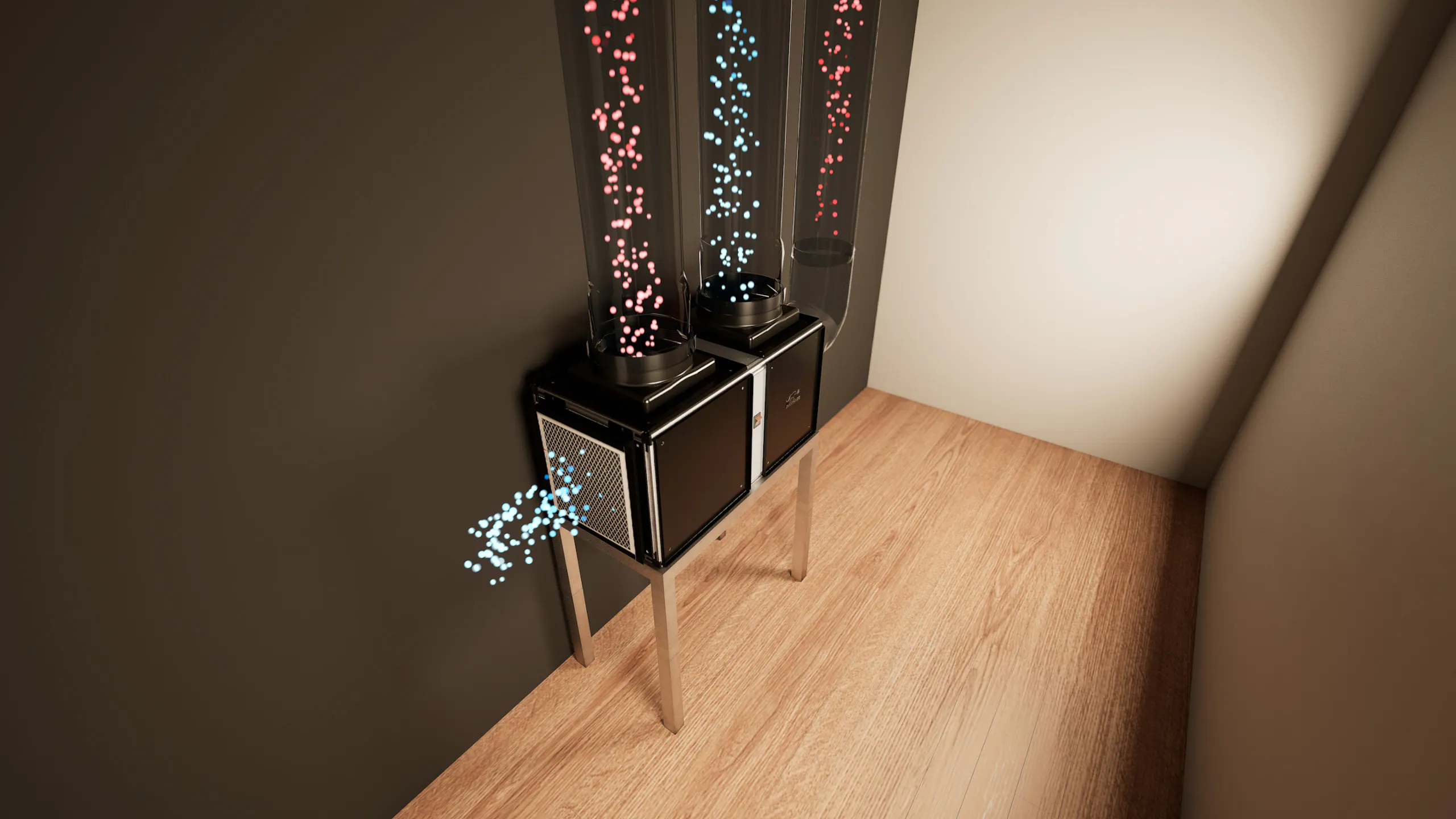
Fully ducted system: The entire mechanical unit - both evaporator and condenser - is installed outside the cellar in an adjacent mechanical space. Cooled air travels into the cellar through ductwork and enters through a simple ceiling or wall register. From inside the cellar, you see nothing. You hear almost nothing.
The ducted system is the architecture of choice for high-end wine cellars, glass-enclosed wine rooms, and any project where aesthetics and silence are non-negotiable.
The Panthaire APEX Series: Ducted Wine Cellar Cooling Built for Canada
Panthaire is a Montreal-based company. Our APEX systems were developed with Canadian conditions as the baseline, not an afterthought. The APEX series covers residential and commercial wine cellar projects of every scale.
APEX 3500 - Designed for residential wine cellars up to 1,000 cubic feet. The most popular APEX unit in Quebec for home wine room installations, both new construction and renovation.
APEX 5000 - For mid-range cellars from 1,000 to 2,000 cubic feet. Commercial-grade performance in a format sized for larger residential projects and small commercial applications.
APEX 7000 - Large-scale installations. Commercial wine programs, restaurant cellars, hotel wine rooms, and serious private collections where the inventory represents significant financial value.
What sets the APEX apart in the Canadian market:
52 dB operating noise level. Among the quietest fully ducted wine cellar cooling systems available in Canada. A normal conversation registers at 60 dB. The APEX runs below that threshold, making it appropriate for wine rooms adjacent to living spaces, home offices, or bedrooms.
R290 natural refrigerant. R290 is a natural hydrocarbon refrigerant with near-zero global warming potential. While competitors still operate on R134a - a refrigerant being phased out under Canadian and international environmental regulations - the APEX runs on a refrigerant that exceeds current compliance standards and is positioned for the regulations coming in the next decade. You are not investing in a system that will face regulatory obsolescence.
Standard 6-inch ductwork. APEX units connect to standard 6-inch HVAC ductwork used across Canada. Every certified refrigeration and HVAC contractor in Quebec works with this format. No proprietary components, no manufacturer-exclusive installation requirements, no service lock-in.
Canadian support and service. Parts available in Canada. Technical support based in Montreal. No cross-border shipping delays, no service calls routed through American call centers.
When a Ducted System Is the Right Choice for Your Wine Cellar
A ducted wine cellar cooling system is the correct specification if any of the following apply to your project.
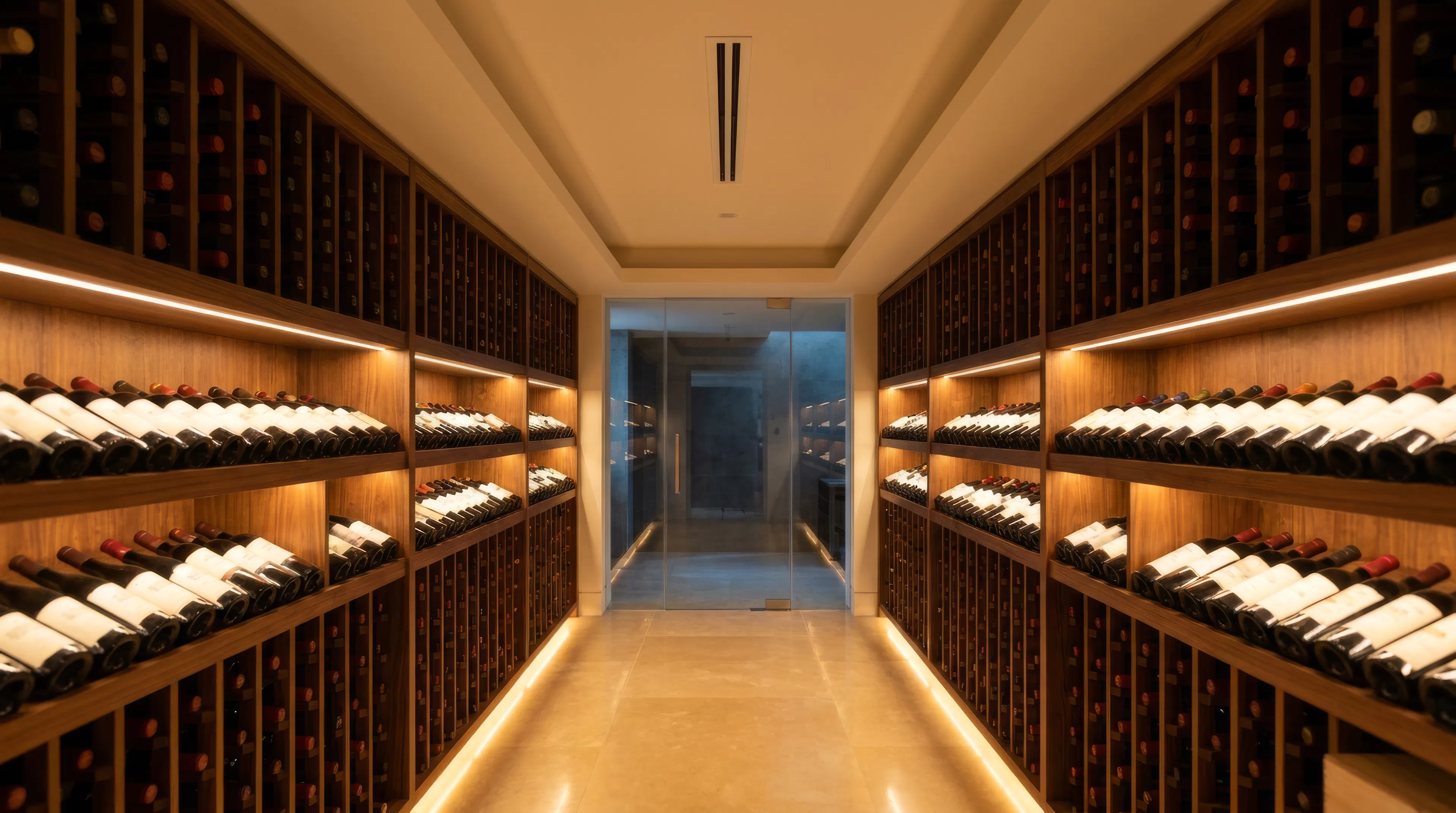
Your cellar is integrated into finished living space. A wine room embedded in a finished basement, adjacent to a dining room, or visible from a main living area requires a solution that leaves no mechanical footprint inside the cellar. Ducted is the only option that delivers this cleanly.
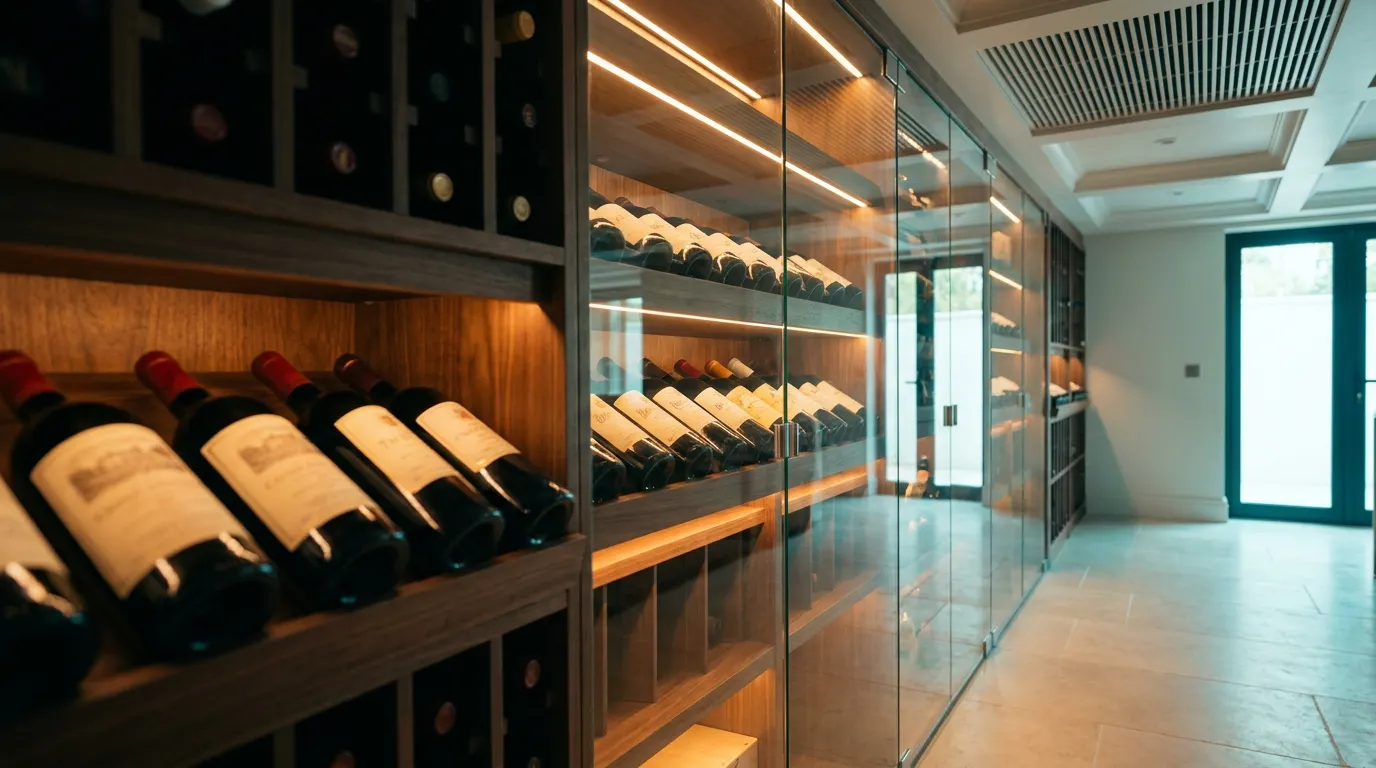
You have a glass wine cellar or wine wall. Glass-enclosed wine cellars are increasingly popular in high-end residential projects across Quebec and Ontario. They are also acoustically unforgiving - every decibel of unit noise travels through glass. And aesthetically, any visible unit mounted inside a glass enclosure compromises the entire visual intent of the design. Ducted eliminates both problems simultaneously.
Your collection exceeds 300 bottles. Below this threshold, a well-specified through-the-wall unit can provide adequate cooling. Above it, the thermal load, the value of the inventory, and the investment horizon all point toward a ducted system with the temperature stability and longevity that a serious collection requires.
You are building or renovating now. Ductwork integrated during construction costs a fraction of what it costs to add after the fact. If you are at the framing stage or planning a renovation, this is the window to specify a ducted system properly. Waiting until the walls are closed doubles or triples the installation cost.
Silence matters. If your wine cellar is within earshot of your living space, the 52 dB operating level of the APEX changes the daily experience of living with the system. Through-the-wall units operate between 60 and 70 dB. That difference is not subtle.
Sizing a Ducted Wine Cellar Cooling Unit: What You Need to Know
Choosing the wrong size is the most common and most consequential mistake in wine cellar cooling. An undersized unit runs continuously, never reaches target temperature, and burns out years ahead of schedule. An oversized unit short-cycles - turning on and off too frequently - creating temperature fluctuations that damage wine over time.
Proper sizing for a wine cellar in Quebec requires accounting for:
Cellar volume measured in cubic feet (length x width x height).
Insulation quality - a properly insulated wine cellar with R-19 or better wall insulation and a well-sealed vapor barrier requires significantly less cooling capacity than an under-insulated space.
Glass surface area - glass has a much lower R-value than insulated walls. A cellar with significant glass exposure requires additional cooling capacity to compensate.
Ambient temperature differential - the difference between your target cellar temperature (typically 55°F / 13°C) and the maximum ambient temperature in the adjacent mechanical space. In a Montreal basement in July, this differential is manageable. In an above-grade installation exposed to summer heat, it is significantly larger.
Heat sources - lighting inside the cellar, piping, or proximity to HVAC equipment all add thermal load that must be accounted for.
Panthaire provides free BTU calculations for project consultations. If you are sizing a system, do not rely on a rough estimate. The 15-minute calculation conversation protects a decision that will affect your cellar for the next two decades.
The Real Cost Calculation for Wine Cellar Cooling in Canada
The price of a ducted wine cellar cooling system is higher than a through-the-wall unit. This is not in dispute.
What is also not in dispute: a well-specified ducted system installed correctly lasts 15 to 20 years. A compromised installation of an under-engineered system often requires replacement in 5 to 8 years - particularly in a climate as demanding as Quebec's.
The more important calculation is the value of what the system protects. A 500-bottle cellar containing wines of modest average quality represents $15,000 to $25,000 in inventory. A cellar of serious Burgundy, Bordeaux, or well-aged Napa can represent multiples of that. Temperature instability, improper humidity, or cooling system failure does not pause the aging of your wine. It accelerates and degrades it.
The equipment that protects the inventory is not the place to optimize for purchase price.
Installation: What to Expect for a Ducted Wine Cellar Cooling System in Quebec
APEX system installation requires a certified HVAC-R contractor. Panthaire works with an installer network across Quebec - Montreal, Quebec City, Laval, Longueuil, South Shore, North Shore, and the broader province.
A standard installation involves:
Site assessment - cellar dimensions, insulation specification, available mechanical space, electrical access, and condensate drainage routing.
BTU calculation and unit specification - matching the correct APEX model to the confirmed heat load of the space.
Ductwork installation - 6-inch supply and return runs from the mechanical unit to the cellar registers, sealed at every joint.
Electrical connection - dedicated circuit per manufacturer specification.
Commissioning - temperature setpoint calibration, condensate drainage verification, and operational testing.
Total installation time for a standard residential project is one to two days depending on the complexity of ductwork routing.
Frequently Asked Questions: Ducted Wine Cellar Cooling in Canada
Can I install a ducted wine cellar cooling unit myself? No. A ducted system like the APEX requires a certified HVAC-R technician for installation and commissioning. This is not a limitation - it is a specification that ensures the system performs as designed and that warranty coverage is maintained.
Does the APEX work in Canadian winters? Yes. The APEX series is specified for Canadian ambient temperature ranges. Winter operation in Quebec basements is within normal operating parameters.
What is R290 refrigerant and why does it matter? R290 is a natural hydrocarbon refrigerant with a global warming potential (GWP) of 3 - compared to 1,430 for R134a. Canadian environmental regulations are progressively restricting high-GWP refrigerants. Specifying an R290 system today means your equipment is compliant with both current and anticipated future regulations.
How loud is the APEX inside the cellar? At 52 dB operating level, the APEX runs below the threshold of normal conversation. For glass cellars or wine rooms adjacent to living spaces, this is the specification that makes the system livable.
Does Panthaire offer service in Quebec outside Montreal? Yes. Panthaire works with certified installer and service partners across the province.
Get a Free Quote for Your Wine Cellar Project in Quebec or Canada
Panthaire provides free project consultations for residential and commercial wine cellar cooling installations across Quebec and Canada. Our team reviews your space, calculates your heat load, and recommends the correct APEX system for your project - no obligation.
Info@panthaire.com
Or speak directly with a Panthaire specialist about your wine cellar cooling project.
Panthaire APEX
Not sure which cooling unit your cellar needs?
Panthaire APEX systems ship direct to all 48 contiguous U.S. states — engineered and assembled in Canada, free shipping, 2-year parts and labor warranty. Enter your room dimensions, glass area, and insulation and the calculator recommends the right unit.