December 18, 2025
Wine Investment 2026: Real Bottles, Real Returns
Wine investment in 2026: real price jumps, real risks, and why ducted cooling protects your collection's resale value.
Written and reviewed by
Panthaire HVAC Engineering Team · Licensed HVAC · Wine Cellar Cooling Specialists
The team that engineers APEX is the same team that ships it and answers the phone when installers call.
Last reviewed · July 2, 2026
Reading time
4 min
~848 words
Sizing a wine cellar? Get the right APEX unit for your room in two minutes.
Free BTU calculatorWine Investment in 2026: What Makes a Bottle Worth More Than You Paid
A bottle bought at release can sell for many times its original value a decade later.
Not always. Not most bottles. But it happens often enough that people keep asking about wine as an investment.
Here's the honest version: wine can rise in value. Wine can also fall. And the difference between a bottle that sells easily and one that gets questioned is often not the label. It's the proof that it was stored properly.
Why Some Bottles Appreciate
Wine supply shrinks over time. People drink it. Restaurants pour it. What's left becomes scarcer.
A winery makes a fixed amount. Demand can surge because a critic loved a vintage or a new market opened. Meanwhile, bottles keep disappearing. What remains, properly stored, becomes harder to find.
Some bottles have doubled or tripled from release over a decade. But the gains aren't automatic. They depend on the wine, the vintage, the timing, and how it was kept.
Why Wine Can Also Drop
Wine isn't immune to market cycles.
Bordeaux producers cut release prices by more than 30 percent for their 2024 vintage. An index of top Bordeaux dropped nearly 27 percent over two years.
Wine doesn't only go up. The healthiest mindset for 2026: wine is a perishable collectible in a market that moves in cycles.
How Value Gets Destroyed
The market judges what happened to the bottle, not just what it is.
Someone buys great bottles. Tucks them in a basement corner. Summer hits. The basement warms up. Winter hits. It cools down. The bottles ride a temperature roller coaster for years.
When they decide to sell, the buyer asks: Where were these stored? How stable was the temperature? Any proof?
Suddenly you're selling a mystery. Mysteries get discounted.
Heat pushes corks and dulls aromatics. Temperature swings are worse.
Vibration disturbs the wine. Constant hum affects how wine evolves.
Missing paperwork kills deals. Buyers want receipts, original cases, clear history.
This is where "smart buy" stories die. Not because the wine was wrong. Because the storage story was wrong.
What Investment-Grade Storage Looks Like
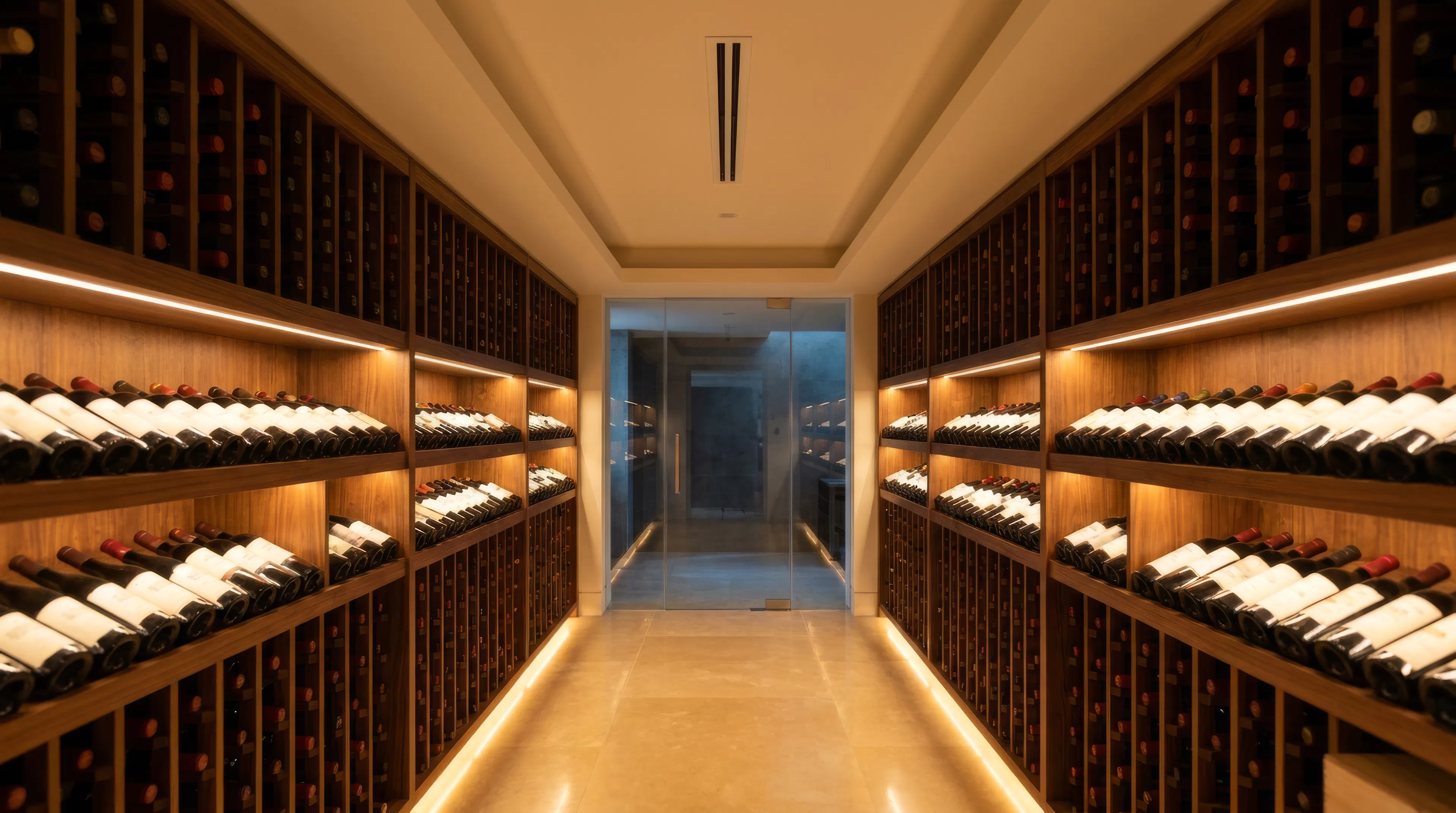
If the bottle is the asset, the cellar is the vault.
Temperature stability is everything. Target 12-14°C (54-57°F), held steady year-round. A cellar that swings 10 degrees between seasons ages wine faster than intended. Auction houses notice. Buyers notice.
Vibration matters. Through-the-wall units put the compressor inside your space. You hear it. Your bottles feel it.
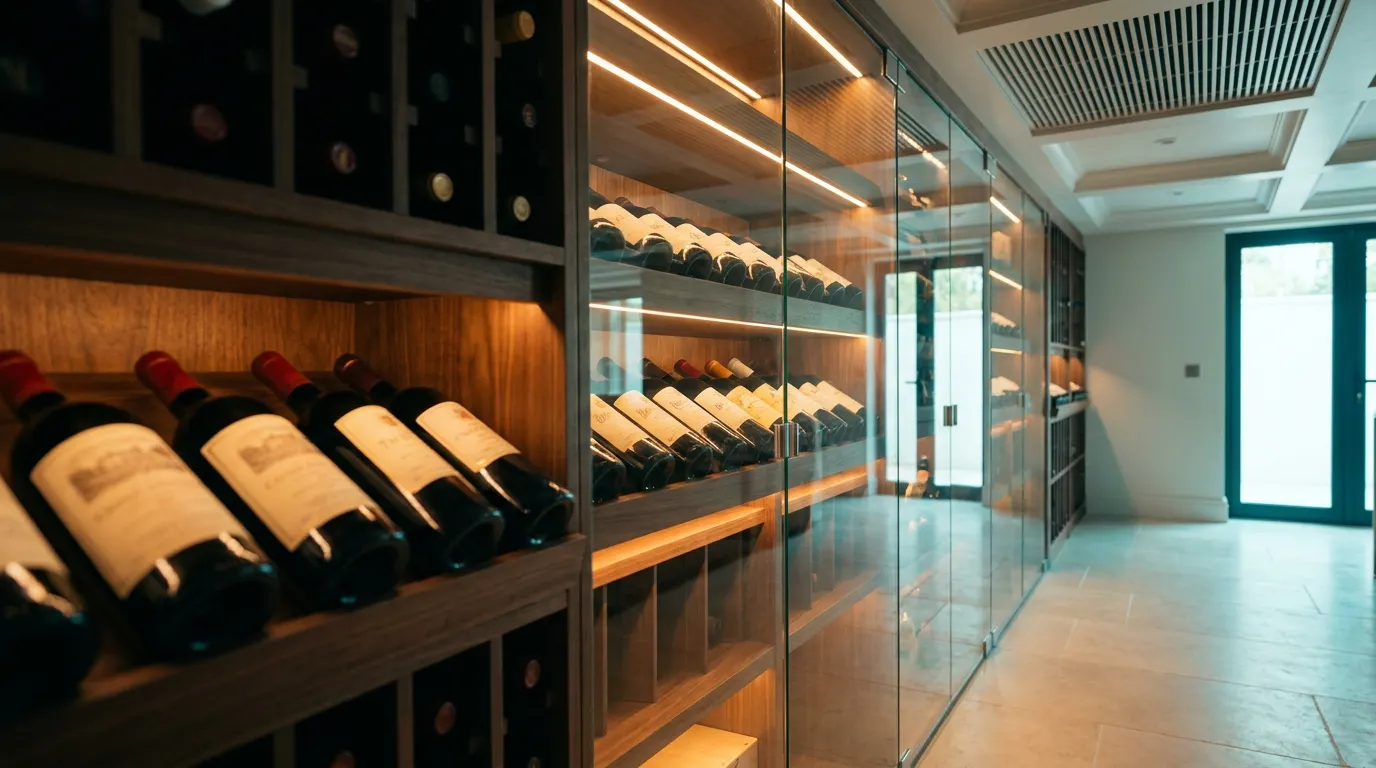
Ducted systems solve both problems. The cooling unit lives outside the cellar entirely. In a utility room, ceiling void, or mechanical closet. The cellar gets gentle airflow through small grilles. No rumble. No visible equipment. Just bottles at rest.
At Panthaire, we build fully ducted systems for this reason. The APEX series delivers stable temperature, near-silent operation, and nothing visible in the cellar except discreet grilles.
Why ducted works better for collectible wine:
Through-the-wall units mean compressor noise and vibration inside your cellar. Plus a bulky grille on your wall.
Ducted systems move everything mechanical out of sight. Quieter. More stable. Better looking. When you sell bottles or the home, that difference matters.
Documentation closes the loop. Temperature logs, receipts, photos. The more you can prove, the more your bottles are worth.
What Buyers Look At
Most buyers never taste your bottle. They inspect it.
Fill level matters. Low fill signals leakage or poor storage.
Label condition matters. Damage narrows your buyer pool.
Original packaging helps. Bottles in original cases sell more smoothly.
When bottles trade for serious value, nobody wants surprises.
Starting Small in 2026
You don't need hundreds of bottles. You need a plan.
Think in years. Five to ten, minimum. Wine doesn't reward impatience.
Budget consistently. Set aside what you can each month. Build slowly.
Get organized. Track purchases. Keep receipts. Keep photos. Note storage conditions.
Store it right from day one. Provenance, patience, stable temperature. Do those three things and you can exit later with buyers who trust the story.
The Quiet Part
Wine investment looks glamorous online. In real life, it's slow and a little nerdy.
The upside is real. But the engine is simple. Buy carefully. Document everything. Store it in stable conditions. Wait.
Protecting a wine investment requires the right cooling system. Without it, resale value erodes quietly.
Ten years from now, you might have a delicious cellar. That's already a win. If the market smiles on a few bottles, you get a second win.
Building the right storage setup is the part most people skip. Don't skip it.
FAQ
Can you make money investing in wine? Some people do. It depends on the bottle, timing, and provenance. Wine is a collectible market with cycles.
How should investment wine be stored? Stable temperature around 12-14°C, minimal vibration, proper documentation. Ducted cooling keeps equipment out of sight and conditions stable.
Why is ducted cooling better? It moves all mechanical equipment outside the cellar. Less vibration, less noise, no visible equipment. More stable conditions.
How long should you hold wine? Think in years. Five to ten is common. Sometimes longer.
Panthaire APEX
Not sure which cooling unit your cellar needs?
Panthaire APEX systems ship direct to all 48 contiguous U.S. states — engineered and assembled in Canada, free shipping, 2-year parts and labor warranty. Enter your room dimensions, glass area, and insulation and the calculator recommends the right unit.